

SIMFEROPOL, Ukraine
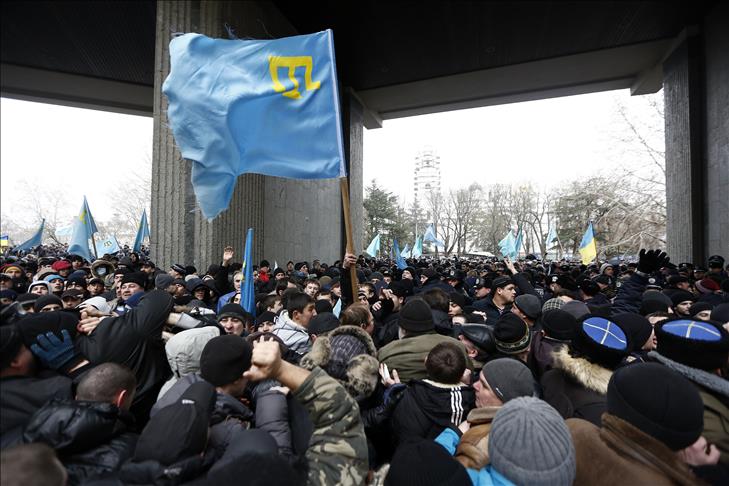
The palatable unease emanating from the small crowd of flag waving pro-Ukraine demonstrators, who had gathered at the foot of a statue to national poet Taras Shevchenko on Saturday, appeared to foreshadow their status in a Crimea that will likely fall under the watchful eye of Moscow following Sunday’s referendum.
The crowd gathered for a hushed rendition of Ukraine's national hymn and a reading of the constitution but many of the participants were resigned to acknowledge that the current situation could rapidly change the course of their lives.
“I'm now afraid to openly state my political views. I work in an orphanage and I am sure I will lose my job if they knew what I thought about the situation. But I can’t sit by and allow this to happen to my country,” said Yevgenia, a 30 year-old Simferopol native. “I will keep my Ukrainian passport and citizenship, even if they are only a memory here.”
Even Russia’s promise of financial assistance to help alleviate Crimea’s deep-seeded economic problems does not convince her.
"Nothing good will come of that. Very little will change here. I don't know of any region in Russia that has a fully self-sufficient economy. Putin will turn it into a giant military base with a few resorts for the Moscow elite,” she said.
Many in the crowd expressed dismay and confusion over the course of events since armed gunmen, believed to be Russian Special Forces, overran Simferopol’s airport on February 27-28.
“We are all Russian-speaking people here. Have you ever heard of any inter-ethnic strife between the communities before the Russian army appeared? In 22 years of independence we never came close to a civil war in Ukraine,” Simferopol native Tatiana said. “I’m half Russian, half-Moldovan, my husband is Crimean Tatar and our daughter competes for the Ukrainian national gymnastics team. We are Crimeans and we want to be Ukrainian citizens.”
“All of this [pro-Moscow nationalism] started about 10 days ago. My Russian friends and I never discussed the idea of Crimea seceding from Ukraine and joining Russia,” said 36 year-old Crimea native Ilona. “But once the Russian TV channels started their campaign, they turned all of them into robots. The Kremlin planned the whole process well in advance. The local parliament already acts as though the results [of the referendum] have been announced.”
When asked about discrimination against Russians and Russian speakers, she said, “Absolutely not. That is a complete fabrication. My husband and I are Ukrainian, but we are native Russian speakers. Our kids are Russian speakers. Furthermore, we (Ukrainians and Crimean Tatars) are minorities here. How can minorities discriminate against anyone?”
The mixed crowd of Ukrainians, Crimean Tatars and Russians who oppose Moscow’s intervention made less of an attempt to rally support for their cause, but appeared to gather as a means of offering support to one another ahead of the referendum.
“We don’t know what we’ll do. But we will never leave our homeland,” 19 year-old Crimean Tatar university students Edem and Ali said. “We’re so confused by what’s happening. Everyone here has friends from all nationalities,” they added.
“We never had a problem with each other. These accusations of discrimination and such, it’s just ridiculous. Russia completely manufactured this crisis,” Edem said.
englishnews@aa.com.tr
Anadolu Agency website contains only a portion of the news stories offered to subscribers in the AA News Broadcasting System (HAS), and in summarized form. Please contact us for subscription options.

Pipeline alternatives, including routes via Türkiye, gain relevance amid Strait of Hormuz concerns
Trump says downed US jet will not affect Iran negotiations: Report
2nd US Air Force combat plane crashes in Persian Gulf region: Report
FACTBOX - Confirmed US fighter jets shot down in modern conflicts
Ankara opposes attacks on lran, Turkish president tells Putin in phone call
