BAKU, Azerbaijan
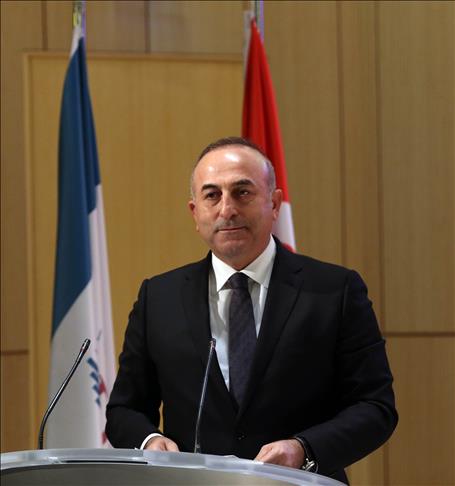
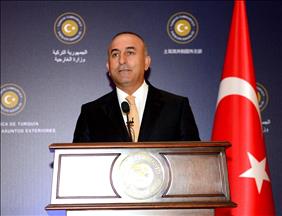
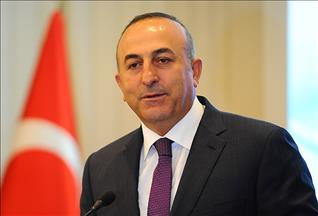
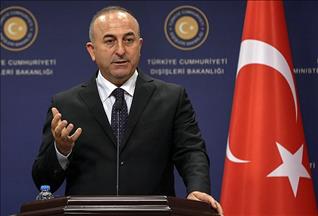
Turkish Foreign Minister Mevlut Cavusoglu slammed Armenia for its suspension of the 2009 diplomatic protocols with Turkey that aimed to normalize relations between the two countries.
Cavusoglu also strongly criticized Armenia’s role in the 1992 Khojaly massacre.
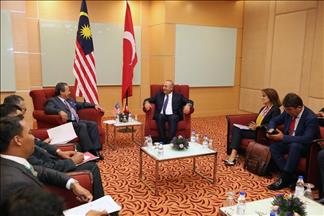
Addressing a joint press conference with his Azeri counterpart Elmar Mammadyarov in Baku on Wednesday, Cavusoglu said, "Armenia could not pass the sincerity test; we see that they are being malevolent against neighbors."
Turkey and Armenia signed the protocols on “establishment of diplomatic relations” and “development of relations” on Oct. 10, 2009, which reflected Turkish state's willingness to normalize relations and resolve all bilateral issues. Switzerland had facilitated the agreement that was signed in Zurich and the protocols were later submitted to respective country’s authority for ratification.
The Armenian government had first sent these protocols to its Constitutional Court to seek its approval. The Armenian court found the protocols to be in line with the Armenian constitution, however, Turkey said the court’s verdict contained contradictory elements to the letter and the spirit of the agreed protocols, Turkish diplomatic sources said.
On April 22, 2010, Armenian President Serzh Sargsyan had suspended the ratification process of the protocols.
Cavusoglu said Armenia was being left out from regional cooperation mechanisms "because of its attitude."
"If they correct their mistakes, stop occupying Azerbaijani territories and respect Azeri territorial integrity, then we can include them to cooperate with the region," Cavusoglu said.
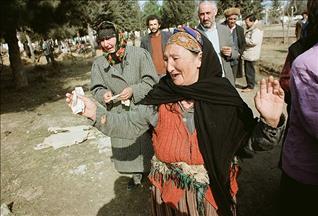
The foreign minister also condemned the 1992 massacre during his visit to Baku that comes on the eve of the 23rd anniversary of "the bloody incident."
"We curse the Khojaly massacre and its perpetrators," Cavusoglu said. "We need to tell what happened in Khojaly and Turkey will always keep this incident on its agenda."
Armenian military forces took over the town of Khojaly in Nagorno-Karabakh on Feb. 26, 1992, and battered it with heavy artillery and tanks, assisted by an infantry regiment.
The two-hour offensive killed 613 Azeri citizens, including 116 women and 63 children and critically injured 487 others, according to Azeri figures.
Armenia’s invasion of Azerbaijan’s Nagorno-Karabakh territory began in 1988 with minor conflicts, but it evolved into a full scale war in 1992.
At the end of the war in 1994, Armenian and Azeri delegations held talks over the status of Nagorno-Karabakh under the supervision of the Organization for Security and Co-operation in Europe's or the OSCE’s Minsk Group.
Currently, Nagorno-Karabakh and seven adjacent districts, which consists of more than 20 percent of the Azerbaijani territory, are still under Armenian occupation.
'One nation, two states'
Cavusoglu reminded the founder of Turkish Republic, Ataturk's words, "Azerbaijan’s grief and happiness are our own," and late Azeri President Haydar Aliyev's quote, "One nation, two states." He said that both countries' governments were strengthening bilateral relations within this scope.
The foreign minister said the economic aim for the two countries was to boost trade volume between the two countries to $15 billion.
Cavusoglu also reminded the TANAP project and the Kars-Tbilisi-Baku railway project between Turkey, Azerbaijan and Georgia, which was projected to enter into service in the second half of 2015.
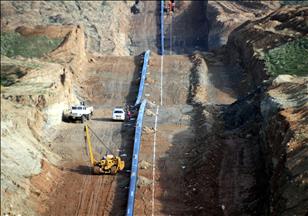
The TANAP is projected to transport natural gas from the Azerbaijani Shah Deniz 2 field in the Caspian Sea and other Azerbaijani fields, through Turkey and to Europe.
The Trans Adriatic Pipeline will connect with TANAP on the east side of the Greek-Turkish border to transport natural gas to the Italian network.
The TANAP project is planned to originate at the Georgia-Turkey border, to pass through Anatolia, and to extend 1,242.7 miles (2,000 kilometers) to reach Greece. It will then connect with the Southern Gas Corridor that will carry natural gas from the Caspian Sea near Azerbaijan to Italy into Europe.
Azerbaijan will also be Turkey's guest at G-20 summit in Istanbul. "Azerbaijan's participation will give Turkey much more power," Cavusoglu added.
Azeri Turks’ release
Mammadyarov raised the issue of Azeri hostages and said he believed Armenia would release the hostages soon.
"Assistant Secretary of State for European and Eurasian Affairs at the United States Department of State, Victoria Nuland, and OSCE Minsk group heads raised the issue during their Yerevan visits," he said. "Armenia cannot keep the two hostages for long. I am confident about the release of the hostages," he added.
The two hostages, along with their friend, were on their way to visit relatives in Kalbajar, a province in Nagorno-Karabakh that is occupied by Armenia, when they were detained by Armenian officials.
Hasan Hasanov was killed by Armenian troops, while Dilqem Esgerov and Sahbaz Guliyev were taken hostage by Armenian officials. Armenia accuses them of “violating territorial rights.”