By Max Constant
BANGKOK
Eight days after a draft constitution was rejected by a military-appointed assembly, the Thai junta is hardening its stance on criticism, with another prominent critic of the junta arrested over the weekend
Prachatai website reported Monday that Pravit Rojanapreuk, a veteran journalist from English language daily The Nation, had been arrested by the military Sunday and is currently being detained at an unknown location.
Nation Group Editor-in-chief Thepchai Yong subsequently called on the junta to immediately release Rojanapreuk.
"There is no justification whatsoever for his detention," he said Sunday.
The Foreign Correspondents Club of Thailand published a statement Monday condemning the arrest and detention.
"The detention of journalists of anyone else for the peaceful expression of their views violates Thailand’s obligations under international human rights law," it said
Meanwhile, Col. Winthai Suwaree, a spokesman for the junta, justified Rajanapreuk’s detention by telling local reporters Monday that some information articles written by the journalist "could cause misunderstanding in society as they were not based on evidence".
He did not give any more details.
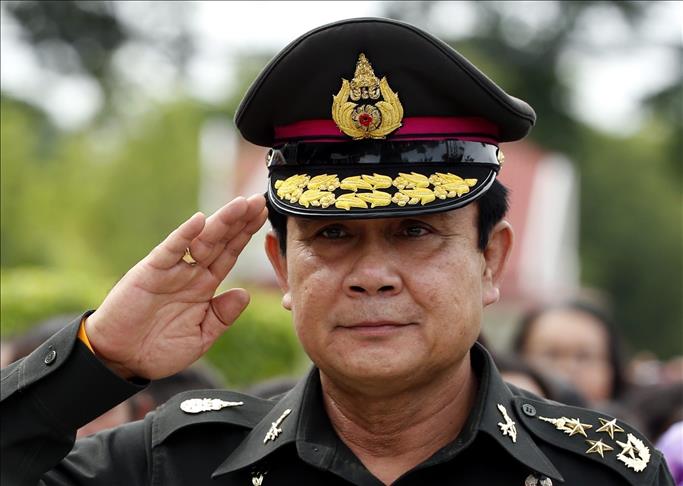
The arrest came days after junta chief-cum-Prime Minister General Prayuth Chan-ocha told reporters that his government would escalate repression against critics.
"I am just going to tape their mouths shut," he said during one of his customary angry outbursts.
"If your children disobeyed your order, would you tolerate that? Those people who like to break the laws, they cannot do that to me," the retired military officer said, referring to those of expressing dissent.
On Saturday, the government’s official news agency confirmed that legal action would be taken against "anyone expressing opinions that could lead to unrest and instability in the country".
The 48-year-old is a well-known critic of the military regime and of the country's lese-majeste law, which punishes offenders with jail terms between 3-15 years for anything deemed to be criticism of the king, queen or crown prince.
He had previously been summoned and detained for several days in the immediate aftermath of the May 22, 2014 coup.
On Sunday, Rojanapreuk -- accompanied by his lawyer and a representative of the United Nations Office for Human Rights -- reported to the military at a Bangkok army base after army officers called at his home Saturday to arrest him.
Two hours later, lawyer Pawinee Chumsri was told that Rojanapreuk had been transferred to another army base, but the military refused to disclose the exact location.
In the wake of last year's coup, the junta summoned hundreds of activists, journalists and politicians deemed critical of the military and detained them for "attitude adjustment" -- meaning that military interrogators tried to dissuade them from expressing their feelings on political issues.
This wave of detentions -- generally for seven days -- withered a few months after the coup, but since the military appointed-National Reconciliation Council rejected a draft constitution Sept. 6, the junta has reverted to the use of arbitrary detentions.
Two former ministers in the deposed government of then prime minister Yingluck Shinawatra, Karun Hosakul and Pichai Naripthaphan, have since been arrested and detained incommunicado by the military because of repeated criticism of junta policies.
The junta also revoked the passport of Chaturon Chaisaeng -- Yingluck’s education minister.
The Sept. 6 rejection of the constitution saw a large majority of the council -- including almost all of the military officers seated in the assembly -- vote against it.
Speaking to Anadolu Agency, an unnamed Thailand-based analyst has described the resulting vote as the junta's realization that "it had overstepped [its authority] by introducing too many anti-democratic clauses in the draft.
The analyst -- who did not wish to be named for fear of reprisal -- said that the junta had manoeuvred to have its own draft constitution shot down because it "was worried that the 2016 planned referendum on the draft constitution would then become a rallying point for all those opposed to the junta".
With the draft rejected, that automatically extended the junta's lifetime by 20 months, the analyst said, as a new reform assembly now has to be set up and a new draft constitution prepared.
After the May coup, the military promised elections would take place at the end of 2015.