By Charles Newbery
BUENOS AIRES, Argentina
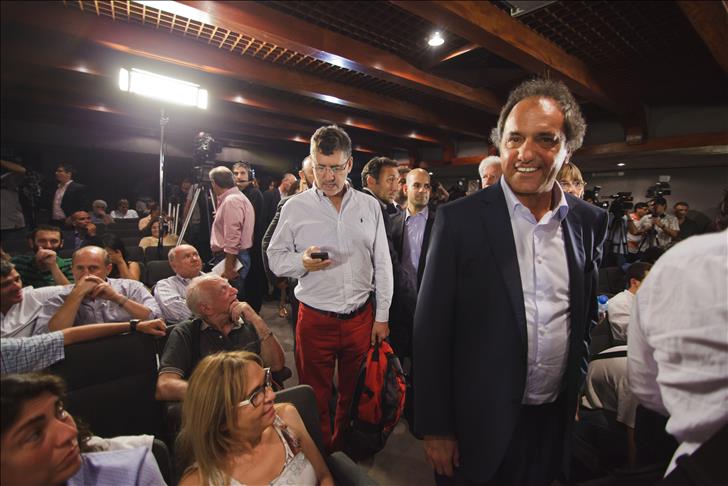
The two-term governor of Buenos Aires is leading in Argentina’s presidential primaries held Sunday.
Daniel Scioli has received 36.4 percent of the votes, according to a preliminary count of 11 percent of the votes by the National Electoral Board.
The first official results were released at 10:45 p.m. local time (0145GMT), more than four hours after voting ended on a stormy day in much of the country.
While Scioli did not run against any candidate for the ruling Front for Victory ticket, the primaries are required of all parties to pick their candidates to take over control of the country in December from President Cristina Fernandez de Kirchner.
Scioli and running mate Carlos Zannini, the president’s legal and technical secretary and one of her closest confidants, will represent the populist Front for Victory party in the Oct. 25 general election with the hope to take office Dec. 10.
The 58-year-old former powerboat racer who lost his right arm while competing in 1989, faces his strongest rival in Mauricio Macri, who got the most votes for Cambiemos – a coalition of more conservative parties.
Cambiemos took 30.3 percent of the votes, of which Macri was ahead with 80 percent of that amount against two others vying to represent the coalition.
In third place with 23.1 percent was Sergio Massa, a congressman and former Cabinet chief for Fernandez de Kirchner.
Macri, a 56-year-old businessman and former president of hugely popular soccer club Boca Juniors, is considered the strongest candidate to potentially beat Scioli and bring an end to 12 years of rule by Front for Victory.
"We all know that we should live better, that we can live better, that we will live better," Macri told supporters after receiving initial results Sunday.
Political analysts suggest Scioli will now have to work hard to curry favor with the middle class to build support to win the general election in the first round. To do so, he must get at least 45 percent of the votes or more than 40 percent plus a 10 percentage point difference with second place.
If not, the election would go to a second round, a scenario that analysts say would increase the chances of Macri winning the presidency as voters who cast ballots for losing candidates could throw their support behind the businessman.
"Argentina has found its way and with this result it is clear that there is a willingness to continue and to build a better Argentina," Scioli told supporters in apparent allusion to the economic and social plan began by his party in 2003.
Whether won in the first or second rounds, the election is expected to usher in a more conservative government, with Scioli said to be more business friendly than 62-year-old Fernandez de Kirchner. Her administration has attacked businesses for raising prices or failing to adequately invest.
Even so, she easily won the 2007 and 2011 elections, building on popular policies to help the poor with child welfare and subsidies started by her husband Nestor Kirchner, who died in 2010.
Nestor Kirchner emerged on the scene from sparsely populated Patagonia, a southern region, to win the presidency in 2003 with Scioli as his vice president. They helped lead the economy out of a 2001-02 crisis, largely thanks to a surge in global prices and demand for soybeans, the country’s biggest export.
When the economy started to slow in 2011 and contract in 2014 with 30 percent annual inflation, however, demand for a change in political rule began to gain pace, led by the middle class, farmers and business leaders.