21 March 2016•Update: 23 March 2016
By Michael Hernandez
WASHINGTON
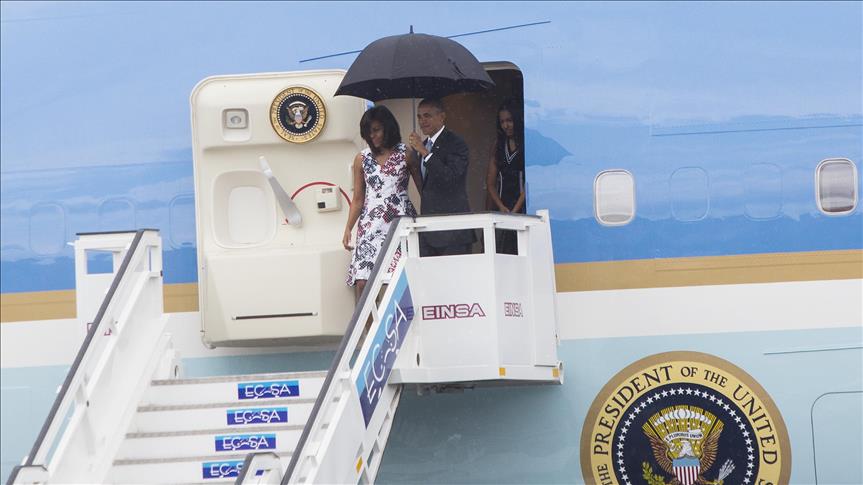
President Barack Obama and his Cuban counterpart, Raul Castro, on Monday vowed to continue the hard work of normalizing ties, despite stark differences about Havana and Washington’s human rights records.
During a joint press conference, Castro opened his remarks with praise for the ongoing effort to normalize relations, stressing its benefits for increased cross-country travel and joint efforts on the environment, but he staunchly defended his communist government’s rights record, which the Obama administration has maintained that it will continue to seek improvements.
In doing so, Castro said his government found it “inconceivable” that any country would not guarantee the right to health care, education, and equal pay. “We defend human rights,” he said in remarks translated from Spanish.
Obama acknowledged that “very serious differences” exist between the countries on freedoms and human rights, saying that he and Castro have had “very frank” conversations on the matter during a bilateral meeting at the Revolutionary Palace.
“We welcome that constructive dialogue” around rights he added in reference to Castro’s critiques.
Asked about alleged political prisoners in Cuban custody, Castro in apparent disbelief asked, “give me a list of the political prisoners and I will release them immediately. Just mention the list. What political prisoners?”
Despite the stark contrast, Obama hailed the diplomatic opening as a “a new day” that was previously “unimaginable” between the Cold War rivals.
“We continue to move forward on many fronts when it comes to normalizing relations,” he said. "I hope that my visit here indicates the degree to which we're setting a new chapter in Cuban-American relations."
Castro added: “Destroying a bridge can be an easy and quick undertaking. However, its solid reconstruction can prove a lengthy and challenging endeavor.”
Among the outstanding issues between the nations are the status of the U.S. naval facility at Guantanamo Bay and continued existence of the U.S. embargo on Cuba.
Castro said it is "necessary to return the territory illegally occupied by Guantanamo Naval Base" in order to advance normalization, but said that the U.S. blockade "stands as the most important obstacle to our economic development and the well-being of the Cuban people".
The Obama administration has taken a number of unilateral actions to dampen the embargo, but congressional action is required for it be fully lifted.
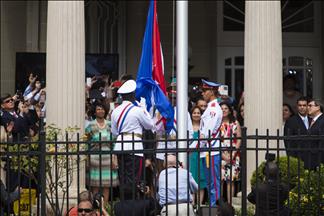
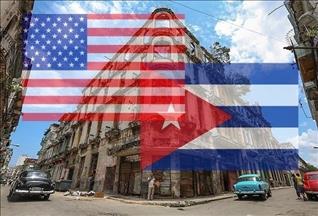
The U.S. and Cuba announced a historic effort to reset relations in December 2014. In the ensuing 15 months, the countries have opened embassies and continued negotiations toward a full normalization.
Washington and Havana severed ties more than a half century ago in 1961.
Monday’s meeting is the third between Obama and Castro during the détente.
They previously met on the sidelines of a regional summit in Panama and at the UN General Assembly in New York. Obama began his second day in Cuba by laying a wreath at the Jose Marti Memorial, a landmark to a Cuban journalist and poet who died fighting the Spanish for the country’s independence.
Hundreds of onlookers flocked to the streets along Obama’s route to the memorial, waving and taking pictures of the presidential motorcade, according to the White House pool.
Obama was greeted at the Revolutionary Palace by a Cuban honor guard and a band that played the national anthems of Cuba and the U.S. -- the U.S.’s coming first in the center of Cuba’s anti-imperialist government.
The American president will depart the island nation for Argentina on Tuesday following a nationally televised address to the Cuban people that the White House said will be “quite powerful”.