17 March 2015•Update: 22 February 2017
WASHINGTON
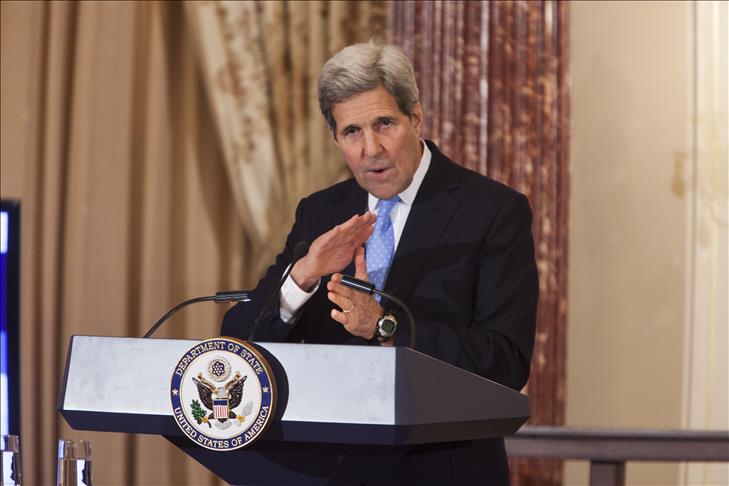
Regardless of his intention, U.S. Secretary of State John Kerry's remarks about negotiations with Syria's Bashar al-Assad has spurred a new wave of debate on US’ Syria policy.
Kerry told the American network CBS News Sunday that talks with Assad were necessary to find a solution to the Syria crisis. "We are working very hard with other interested parties to see if we can reignite a diplomatic outcome," he said in Lausanne, Switzerland. "That's under way right now."
The secretary’s comments raised the question of whether U.S. policy in Syria was shifting on the issue of removal of Assad.
Amr Azzam, an assistant professor at Shawnee State University in Ohio, believed that Kerry only ended up using the wrong words. "It is a really poor choice of words rather than some subtle intentional shifts," Azzam said. "When he said that we need to talk to Assad, it was more in the context of we need to find a way to convince Assad to basically enter a politically negotiated solution,'" he added.
Daniel Serwer, a senior fellow at the Center for Transatlantic Relations at John Hopkins School of Advanced International Studies, on the other hand, said that Kerry uttered a fact that would, in the end, have to come about. "I don’t really see any confusion here. I think the U.S. has always been ready to negotiate with Assad in one way or another," Serwer said. "It is clear he controls the regime’s position, so if you want a political solution you are going to have to reach an agreement with him, directly or indirectly," he added. However, he pointed out, Kerry did not intend a negotiation that would spare Assad as Syria’s president.
Andrew Tabler, an expert on Syria at the Washington Institute for Near East Policy, told The New York Times that the secretary's interview had sent a mixed message. “On the positive side, it shows that Kerry is still determined to pursue a peace settlement in which Assad has to step aside,” Tabler said. “On the negative side, there seems to be no clear strategy within the administration to make this happen,” he added.
State Department deputy spokeswoman Marie Harf also clarified her chief's remarks on her Twitter account hours after the interview. "John Kerry repeated long-standing policy that we need negotiated process (with) regime at -- did not say we (would) negotiate directly (with) Assad," she wrote. “There’s no future for Assad in Syria.”
President Barack Obama and almost all other U.S. officials time and again have said that Assad's removal is part of the solution to the Syrian crisis. But exactly how will Washington bring about such an outcome remains unclear.
Instead of dismantling all apparatuses of the Syrian regime, Azzam said, the U.S. was after a "negotiated transition" that would automatically remove Assad. Kerry's remarks were not intended as from what was layout in Geneva that called for a political transition where Assad had no role, he added.
However, two rounds of talks, which were held in the Swiss cities of Geneva and Montreux, have so far failed, as well as several other UN attempts. One of the main reasons for the failure is the lack of a strong opposition to fight Assad and push him to the negotiation table.
Also, the crises unfolding and deepening in the Middle East has also contributed to the confusion within the U.S. administration concerning Assad’s removal. Daesh has taken control over a large swathe of ungoverned territory in Iraq and Syria, while chaos has rocked Libya and Yemen.
"I think at the moment they (U.S. administration) are hoping certainly that the Assad regime doesn't go too quickly," Thomas Donnelly, a fellow at Washington-based American Enterprise Institute, said. Removal of Assad without a building a credible opposition would mean a victory for Deash and other radical groups within the country, Donnelly said.
Azzam also said that Assad was no longer a priority since the rise of the Daesh threat.
Serwer too agreed and recalled that Washington termed Daesh a more immediate threat than Assad. "But I think the U.S. administration understands that Daesh will remain in Syria so long as Assad continues his repression of the opposition," he added.