29 January 2016•Update: 29 January 2016
By Max Constant
BANGKOK
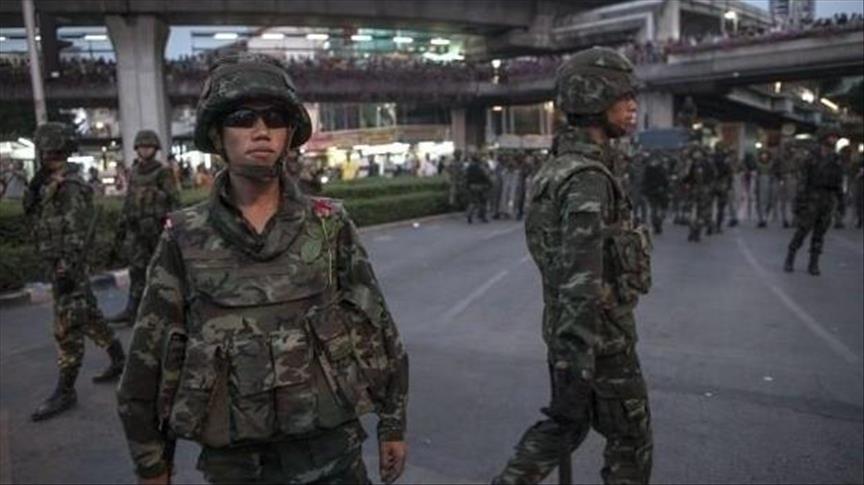
Critics have slammed an initial draft of Thailand's new constitution released Friday, claiming it is little more than an effort by the ruling junta to extend its stay in power.
Among those raising their voices were academics and politicians from the Puea Thai party -- the core party of the government overthrown in the May 2014 coup -- who reacted angrily to the new postponement.
“It is a bad joke” Anusorn Iamsa-ard, the party's deputy-spokesman told The Nation on Friday
He warned that voters would reject the draft because “they will see that this a clear attempt to extend the junta’s time in power.”
The draft, presented to local media Friday and to be finalized by the beginning of April, will be subject to a referendum planned for next July.
If passed, elections will be organised “at the end of 2017,” Meechai Ruchupan, chairman of the constitution drafting committee, told reporters Friday.
Junta chief-cum-Prime Minister Prayuth Chan-ocha has previously said that elections would take place July 2017, having originally postponed them from the end of 2015.
Ruchupan referred to clauses inserted in the draft to allow the junta to stay in power “for 15 more months from the promulgation of the draft constitution” a "normal mechanism".
Members of the Democrat Party -- seen as sympathetic to the regime in the immediate aftermath of the coup -- also laid into the draft Friday, expressing concern about the lack of a plan in the case of the draft not passing July's referendum.
“Everything needs a timeframe. It should be stipulated clearly what is next if the draft does not pass a plebiscite,” said party deputy-leader Nipit Intrasombat,
“The National Council for Peace and Order has to decide on this. Just to continue staying in power is not going to be easy.”
Other clauses in the draft came under fire from academics, particularly those covering the electoral system which request each party forward the names of three candidates for the post of prime minister.
Parliament would then elect the premier from the combined list after the elections.
“This shows that the constitution drafting committee does not understand the democratic system," Sombat Thamrongthanyawong, an expert in public administration, told the Bangkok Post
He criticized the suggested electoral system as unworkable.
Under the terms of the draft, voters select a constituency candidate MP, but all votes cast for losing constituency candidates would then be added up at a national level to calculate votes for party-list candidates.
“This would result in a weak and unstable coalition which the prime minister would not be able to control,” said Thamrongthanyawong.
Unstable government coalitions were the curse of Thai politics in the 1990s, until a new constitution -- drafted after nationwide consultation of the population and aimed at establishing a strong elected government -- was voted in in 1997.
But under the new constitutional framework, billionaire telecommunications tycoon Thaksin Shinawatra was elected in 2001 and re-elected in 2005.
He was overthrown by the military in a Sept. 2006 coup -- as was his sister Yingluck Shinawatra's government in 2014 -- after being accused of corruption and neutralizing the checks and balance mechanisms of the system.
Since then, the Thai conservative class -- comprising military, bureaucrats, owners of local conglomerates and segments of the middle class -- have been dead-set against a strong elected government.