By P Prem Kumar
KUALA LUMPUR
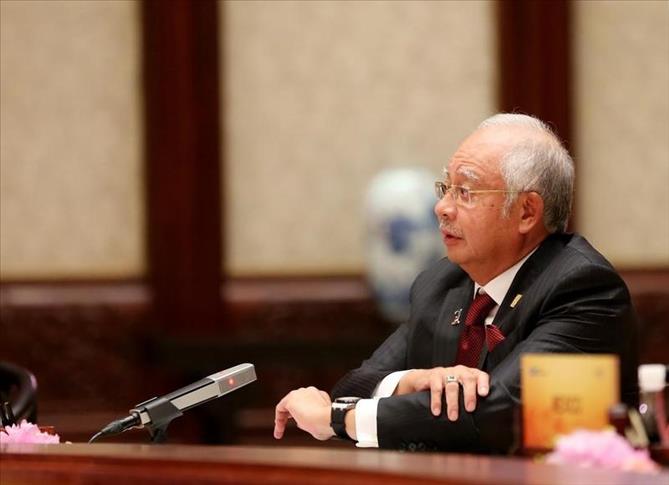
Malaysian Prime Minister Najib Razak has been slapped with a lawsuit by imprisoned former opposition leader Anwar Ibrahim, who is claiming that a donation of 2.6 billion Ringgit ($700 million) paid into the premier's accounts prior to the 2013 election contravenes electoral regulations.
The vice president of Ibrahim’s People's Justice Party, Nurul Izzah Anwar, claimed Wednesday that the fund was utilized by the ruling Barisan Nasional (BN) coalition to win the 13th General Election in May 2013, which nulls the election results.
"This is a follow-up action from The Wall Street Journal report. The facts of the case have exposed various corruption and corrupt tactics used by BN to win the 13th general election," Anwar -- Ibrahim's daughter -- said at party headquarters in Kuala Lumpur on Wednesday.
"It is obvious that the 2.6 billion Ringgit used is more than 26 times the allowed amount as outlined by Malaysian laws."
Malaysian law regulates the maximum fund to be utilized by a political party. Section 19 of the Election Offences Act limits electoral spending to 100,000 Ringgit and 200,000 Ringgit for a state and parliamentary constituency, respectively.
A Wall Street Journal report had claimed that RM2.6 billion from debt-ridden state investment arm 1Malaysia Development Berhad (1MDB) had ended up in the prime minister's personal accounts, only for the Malaysian Anti-Corruption Commission to rule that the money was from personal donations, and not 1MDB.
The civil suit was brought by Ibrahim, Anwar and three other key opposition members, while Razak, BN secretary-general Tengku Adnan Tengku Mansor, 1MDB and the Election Commission were named as defendants.
Anwar said that the legal case would also help Malaysians to discover who the mysterious "donors" were who placed the 2.6 billion Ringgit into Razak's personal bank accounts.
"He will have to reveal the identity of the donor and how was it spent. He cannot escape without explaining that. So, it is for the benefit of all Malaysians."
She added that the Election Commission was included as a defendant as it had also clearly ignored the alleged offence.
BN has governed Malaysia since independence in 1957, but although it formed the federal government after the 2013 general election with 60 percent of parliamentary seats, it only took only 47.38 percent of the popular vote -- its worst ever showing.
The Ibrahim-led People's Pact took 50.87 percent, but failed to form a government, as it did not get a majority of parliamentarians.
Early last month, the Wall Street Journal and Sarawak Report released reports quoting documents from an ongoing probe into 1MDB claiming that money moved among government agencies, banks and entities linked to 1MDB, before finally ending up in the prime minister's personal accounts in five separate deposits.
Razak immediately said that he had not taken funds for personal gain as alleged by political opponents, whether it is from 1MDB, Finance Ministry-owned SRC International or other entities.
Days after, Razak's legal team underlined that the WSJ article had not clarified whether the money was from 1MDB.
When the lawyers sent a legal notice to WSJ's publisher Dow Jones to clarify the article, Dow Jones responded that it stood by the facts and details of the article as it was based on concrete evidence obtained by the international financial paper.
On Aug. 3, the Malaysian Anti-Corruption Commission ruled that the RM2.6 billion was from personal donations, and not from 1MDB.
The finance ministry-owned investment vehicle established in 2009 has run up debts of RM42 billion in just six years of business.