Anadolu Ajansı © 2026


By Michael Hernandez
WASHINGTON
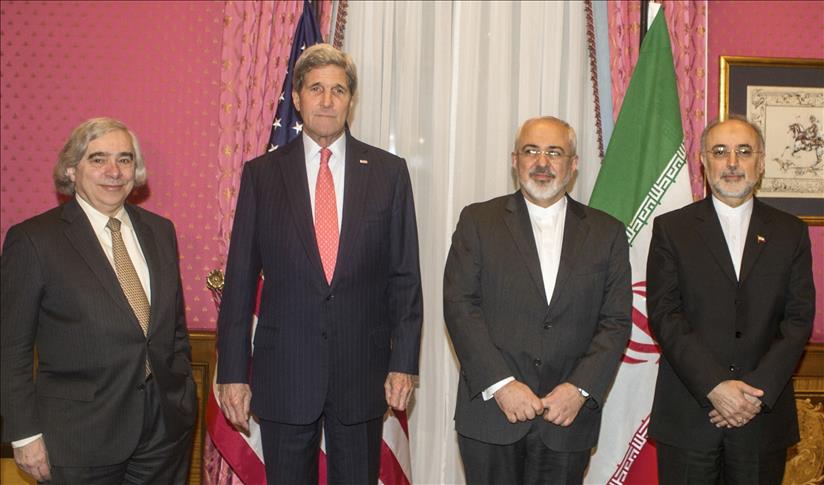
Diplomats and global leaders have lauded a recently brokered framework accord between Iran, the U.S. and other world powers, but experts are divided on its benefits.
“What transpired may not be a milestone, but it’s certainly a victory for diplomacy,” said Daniel Brumberg, special advisor for Iran at the United States Institute of Peace. “The alternative would have been the collapse of the process and possibly a resort to the use of armed force and violent conflict.”
President Barack Obama heralded the “historic” agreement, telling reporters at the White House that it “will make our country, our allies and our world safer.”
“This framework would cut off every pathway that Iran could take to develop a nuclear weapon. Iran will face strict limitations on its program, and Iran has also agreed to the most robust and intrusive inspections and transparency regime ever negotiated for any nuclear program in history,” he said.
The accord is a broad outline of a final comprehensive deal that negotiators have until June 30 to finalize, but the parameters agreed to Thursday set up what is likely to be a flurry of diplomatic activity in the months ahead.
As part of the agreement, Iran's enrichment and enrichment research will be limited for the next 10 years to ensure that the country's break out time – how long it would take for it to build a nuclear weapon should it break from the agreement – is a year. Beyond the 10-year period, Iran will abide by previous enrichment obligations made with the International Atomic Energy Agency, the UN’s nuclear watchdog, with additional details to be hammered out in a final comprehensive deal.
The Islamic republic has agreed to reduce its installed centrifuges by roughly two-thirds – down to 6,104 from the 19,000 that are currently in place, according to the State Department. Of the 6,104 centrifuges, all will first-generation centrifuges, and only 5,060 will enrich uranium for the next 10 years.
Iran has also agreed not to enrich beyond 3.67 percent, and to convert its nuclear facility at Fordow into a research center that will not work on enrichment for at least 15 years.
Inspections by the IAEA will also expand to include regular access to all of Iran’s nuclear facilities, including Fordow and Natanz.
The U.S. and EU have committed to suspending their wide-reaching nuclear-related sanctions on Iran, which they attribute to bringing Iran to the negotiating table in the first place, once the the IAEA verifies Iran has fulfilled all of its nuclear-related commitments.
Some, particularly those in Congress, dispute the purpose of those sanctions.
“There are many on the (Capitol) Hill who viewed sanctions not as mechanism to be bargained away in an agreement, but as a mechanism to weaken Iran, either as a vehicle for regime change, or as a prelude to some sort of military confrontation,” said Brumberg.
James Carafano, the director of the Douglas and Sarah Allison center for foreign policy studies at the Heritage Foundation think tank, said that the administration has “flipped the sanctions on their head” by using them to get Iran to negotiate.
“The purpose of the sanctions was to punish the regime, and to keep them from doing dangerous things,” he said.
All UN Security Council resolutions will also be lifted when Iran completes its “nuclear-related actions addressing all key concerns,” but they could be re-imposed following “an issue of significant non-performance” that cannot be resolved by the parties.
“In all, this is a very positive step, and I think it makes it much more likely that they’re going to work very hard to come to a full agreement by the end of June,” said Brumberg.
Not everyone is convinced that the announced framework will ultimately be beneficial.
Resistance to the deal on Capitol Hill, which has been, at best, suspicious of the administration’s negotiating efforts, was immediate and unrestrained.
House Speaker John Boehner lambasted the deal, saying in a statement that after visiting leaders in Jordan and Israel this week, his concerns about Iran “have only grown.”
“It would be naïve to suggest the Iranian regime will not continue to use its nuclear program, and any economic relief, to further destabilize the region,” the Ohio Republican said.
Veteran Sen. John McCain said that the agreement “raises serious questions and concerns.”
“We must recognize that Iran is clearly on the offensive across the Middle East. Its malign activities, from Iraq and Syria to Lebanon and Yemen, are provoking a regional sectarian conflict of massive proportions,” he said.
Rather than deter the Islamic republic, the deal may serve to incentivize its other illicit activities, said Carafano.
“The way the Iranian regime is going to interpret this is, ‘you have just sanctioned everything we’re doing, and therefore we’re just going to keep doing what we’re doing,’ whether that’s state sponsorship of terrorism, or oppression of the human rights of their own people, or even cheating on the deals that they’ve abridged in the past,” he said.
“The way this framework was rolled out, I think it will be impossible for the U.S. Congress to impose itself in the middle of the process now,” he added.
Israeli Prime Minister Benjamin Netanyahu, who has strongly lobbied Congress and world leaders to oppose a deal, told Obama Thursday that a final deal based upon Thursday’s agreement “would threaten the survival of Israel,” according to his Twitter account.
Brumberg, the Iran advisor at the United States Institute of Peace, said that without U.S. support for a military campaign to neutralize Iran’s nuclear program, Israel doesn’t “have the munitions to produce the results that they want, so they are reduced to assailing an agreement.”
“In the wake of these very bad relations, there will certainly be those in and around Bibi’s government who will say that the time has come to back off. The questions is whether these more moderate voices, and pragmatic voices, will gain the upper hand or not,” he said, using a nickname for Netanyahu.
news_share_descriptionsubscription_contact

contact_the_ombudsman
is_there_an_error_in_this_story