SRINAGAR, India
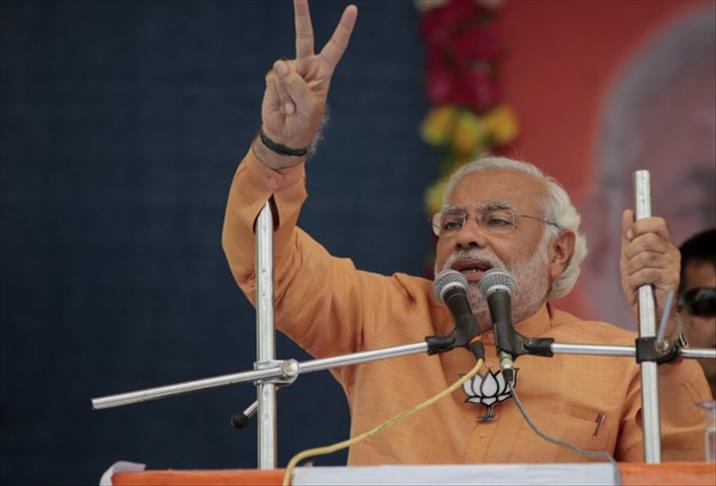
Indian Prime Minister Narendra Modi has visited Indian-held Kashmir (IHK) for the first time since coming to power.
The right-wing Hindu leader who is greeted by massive crowds in Indian cities and towns, instead faced a deserted city in Srinagar overflowing with Indian armed personnel in the IHK on Friday as people observed a shutdown in protest against his visit to the disputed valley.
Markets, business premises and private offices were closed in the valley and public and private transport remained off the roads after the resistance leadership of IHK called for the protest two days earlier.
The prime minister went directly to the Indian Army’s strategic 15 corps cantonment at Badamibagh after reaching Srinagar, the capital city of IHK, to address more than 1,000 Indian soldiers.
He did not address any gatherings of people in a similar vein, as he had avoided coming to the Muslim-majority Kashmir during his election campaign.
- Curfew imposed
Modi also went to the Uri area to inaugurate the 240-Megawatt Hydro Electric Project situated near the Line of Control.
Heavy contingents of Indian Armed forces had been deployed all over the IHK since Thursday night to ensure that Modi’s visit went hassle-free.
In Srinagar’s old city, an unannounced curfew was imposed to stop any protests, but people came out and shouted pro-independence slogans in Maisuma in Lal Chowk area and also launched balloons into the sky with ‘"Quit Kashmir" and "Free Kashmir" written on them.
Before coming to Kashmir, Modi had first gone to the Hindu majority Jammu division where he flagged off the train service that will go from Katra, a small town known for the Vaishno Devi Hindu shrine, to New Delhi.
Modi addressed crowds and spoke about winning the hearts and minds of Kashmiris.
“This train will not only ease the journey of pilgrims, but also help the region in development,” Modi said.
- Thousands killed
He flew back to New Delhi later in the evening.
Kashmir, a Muslim-majority Himalayan region, is held by India and Pakistan in parts and claimed by both in full.
The two countries have fought three wars – in 1948, 1965 and 1971 – since they were partitioned in 1947, two of which were fought over Kashmir.
Since 1989, Kashmiri resistance groups in IHK have been fighting against Indian rule for independence, or for unification with neighboring Pakistan.
More than 70,000 people have reportedly been killed in the conflict so far.
http://www.aa.com.tr/en