12 January 2016•Update: 12 January 2016
TAIPEI
As millions of Taiwanese voters prepare for this weekend’s general election, those who spoke to Anadolu Agency on Monday expressed their expectations about the economy and the impact of relations with China.
While Jang Surong said that no matter what result, what mattered is a “better Taiwan,” Wang Boixun expressed disappointment at having to choose between two parties that are in stark contrast to one another.
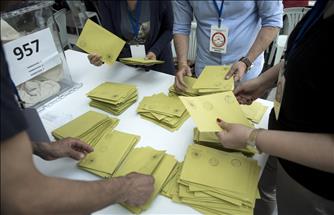
A turnout of around 70 percent is expected among the 18.6 million voters eligible to cast ballots for their next president and 113 parliament members at 15,600 polling stations Saturday.
The presidential race is projected to be split between the candidates of the now ruling nationalist Kuomintang Party – which supports the “one China” policy under the 1992 Consensus – and the more liberal Democratic Progressive Party (DPP) that does not recognize the existence of the deal.
The parties are being represented by Eric Chu and Tsai Ing-wen, respectively, while James Soong is serving as the candidate of the center-right People First Party.
The latest surveys indicate that Tsai is expected to lead the race with around 40 percent of votes, while Kuomintang may secure the most parliamentary seats – a cause for concern among Taiwan’s people.
While Kuomintang considers unification with China “negotiable”, the DPP exhibits a more restrained stance despite its “not leaving relations with the mainland outside assessment” rhetoric.
Jang Surong told Anadolu Agency Monday that voters would prioritize their economic expectations in the election.
“In the last years, our economy has been negatively impacted, I expect that to change after the elections,” he said.
Referring to a historic November meeting between the current presidents of Taiwan and China, Jang said that relations between the sides would have a major impact on the polls and that the first such meeting in around 70 years “means dialogue, which is always an opportunity.”
Since Chinese nationalist leaders fled to Taiwan in 1949 after a brutal civil war with Mao Zedong's Communists, China has seen the region as a breakaway province that will eventually return.
Wang Boixun told Anadolu Agency that the election would center on the economy and relations with China, which he said are related.
“While Taiwan is becoming more and more dependent on China economically, there is an attitude against getting close politically,” he added.
“Kuomintang and the DPP are in stark contrast to each other. Taiwan has still not managed to have a moderate party that will find a common ground. It is saddening to be forced to elect one of the two,” Wang said.
Referring to those who describe the Nov. 7 meeting between China’s Xi Jinping and Taiwan’s Ma Ying-Jeou as “betraying Taiwan,” he underlined that “peaceful dialogue is always good”.
“What we need the most is some logic in these days,” Wang said.
Meanwhile, Yang Xibo argued that Kuomintang had not passed the test during their latest eight-year rule, calling their election promises “vague and far from understandable.” He said he was, however, approaching the DPP hesitantly.
Xiu Lili, who lived in the United States for more than ten years, expressed expectations that the new president would be “a person who will work to make Taiwan shine in the international arena”.
“We, as the Taiwanese people, only belong to Taiwan. I am a Taiwanese, not a Chinese,” she stressed.
Outgoing President Ma Ying-jeou, who will be leaving office after fulfilling the constitutional two-term limit, had been criticized for his approach to relations with China, but Kuomintang still has the largest base in Taiwan.
In addition to the presidential race, the election will see a total of 354 candidates run for parliament in 73 districts.