ANKARA
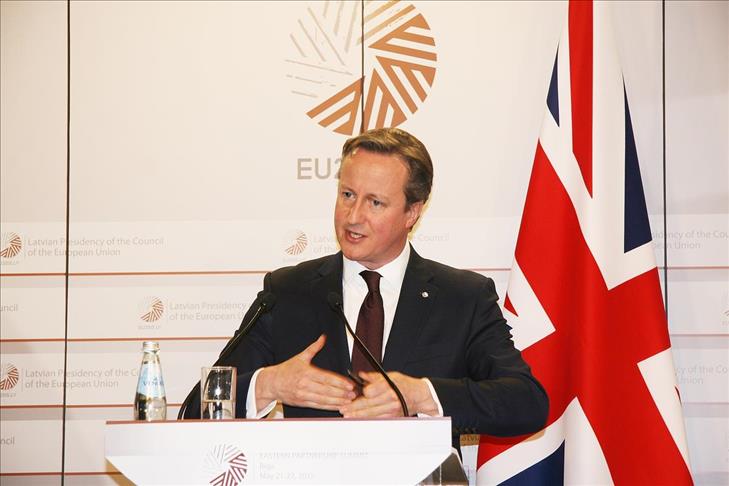
British Prime Minister David Cameron started his drive to reform the terms of Britain’s EU membership on Friday.
“It is an opportunity to start some of the discussions about the reform of the European Union. There will be ups and downs, you’ll hear one day this is possible, the next day something else is impossible,” he told reporters at an EU summit in Latvia.
The summit was dominated by the tensions between Ukraine and Russia, but Cameron used the opportunity to outline what he sees as Britain’s frustrations at the current state of the EU.
Britain historically has strong relations with the eastern former Soviet countries who were present at the summit.
Cameron will try to sway Jean-Claude Juncker to his point of view next week when he meets the EU commission president at Chequers, the British premier's official country house retreat.
The British Prime Minister will also meet German Chancellor Angela Merkel and French President Francois Hollande next week.
“One thing throughout all of this will be constant and that is my determination to deliver for the British people a reform of the European Union so they get a proper choice in that referendum we will hold before the end of 2017,” the British prime minister said.
Cameron’s center-right Conservative Party won an outright majority in the general election earlier this month and has pledged to hold an in-out EU referendum by 2017 after negotiations to reform the terms of Britain’s membership.
Their main priority is to decrease migration to the U.K. but other EU countries, particularly Germany and the former Soviet states, have previously described the free movement of people as a non-negotiable issue.
Former EU commissioner Gunter Verheugen, from Germany, told BBC Radio 4 on Friday that the free movement of people would “absolutely not” be negotiated.
To get around this, the U.K. is proposing withholding benefits from new EU migrants for a period of four years, which it hopes will lead to less people coming to Britain. Verheugen agreed in his interview that this could be a possibility.
“One of the questions within that is further tightening on welfare benefits. So for example, for in-work benefits, people would have to be here for a period of time, would have to live here for four years before they could claim that,” Home Secretary Theresa May told BBC Radio 4.
Britain is also pushing to be exempted from the EU’s commitment to creating an "ever-closer union."
“When the whole debate started, there was clearly a strong opinion that the U.K. would be an affordable loss,” Verheugen said. “I think that people are now much more aware that the United Kingdom is crucial not only for the economic future of Europe, but in particular for the political future of Europe.”