Brazil president vote: Rousseff-Neves runoff confirmed
With nearly all votes counted, a second round is confirmed for the presidential election between President Rousseff and center-right candidate Neves.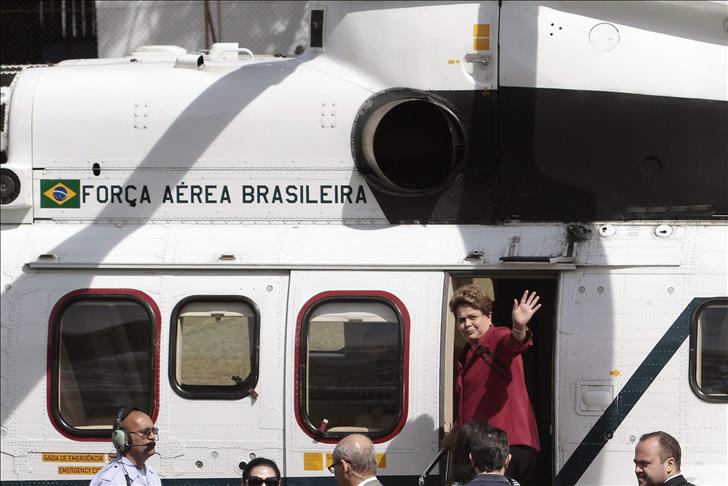
By Ben Tavener and Lucy Jordan
SAO PAULO/BRASILIA
Brazil's presidential election will go to a second-round between President Dilma Rousseff and center-right candidate Aécio Neves, the country's Supreme Electoral Court told The Anadolu Agency (AA) on Sunday evening.
With nearly all of the country's electronic votes counted, none of the 11 candidates reached the required 50 percent threshold, and a second-round runoff will be held Oct. 26.
At 9 p.m. Brasília time (0000 GMT), Rousseff, the Workers' Party (PT) candidate who is seeking a second four-year term, garnered more than 41 percent of votes in Sunday's election, a first round she was expected to win.
However, even with all remaining uncounted votes, she would now not be able to win the election outright, the court confirmed to the AA.
Following her victory Sunday, Rousseff gave a victory speech in which she promised to clean up government and thanked her "dear companion and friend Lula."
Rouseff lauded her political mentor, former President Luiz Inacio Lula da Silva, and thanked him for her political career.
"Without Lula i wouldn't have arrived, I wouldn't have had the option to help fight for a better Brazil," she said. "The fight continues."
The president also promised Sunday a new and better Brazil, including political reform, if she wins in the runoff.
"New ideas, for social policies ... new ideas to bring Brazil into a new century of development: more modern, inclusive, productive, and competitive," she said. "My government has a deep moral foundation that is based on two values: equality of opportunity to all, to guarantee the evolution of our society, and second, to combat corruption."
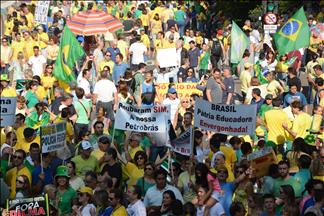
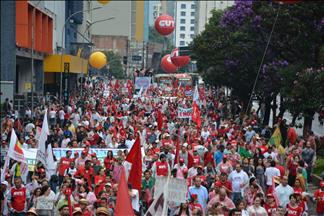
The election was widely seen as a referendum on the last 12 years of Workers' Party rule, particularly after the mass anti-government protests that saw more than a million demonstrators take to the streets across Brazil last year.
With 33.8 percent of votes, Neves, the Social Democracy Party (PSDB) candidate and market favorite, had far more support than any pre-election poll predicted, despite surging to overtake former environment minister and Socialist Party (PSB) candidate Marina Silva on the eve of the election, the latest of many twists in this year's dramatic race for the presidency.
Had Neves not gone through to the decider, it would have been the first time since 1989 without the traditional electoral tug-of-war between the Workers' and Social Democracy parties.
Silva received around 21 percent of votes to take third place, and is eliminated along with eight other candidates.
Silva, who also finished third in the 2010 presidential election, had shot through the polls after stepping up to run for president after the death of running mate Eduardo Campos, and at one stage appeared to threaten Rousseff's re-election. However, support dwindled in the final stages of the first-round campaign.
The only other candidate to poll above one percent was left-wing PSOL party candidate Luciana Genro, who received around 1.5 percent of support.
The coming days are now key for the two remaining candidates to negotiate and redraw political battle lines, securing the support of eliminated candidates ahead of the second round in three weeks' time.
State-level elections, where Brazilians elected deputies, senators, state governors and state-level legislators, saw the PSDB's Geraldo Alckmin re-elected as São Paulo governor despite widespread concerns over the possibility of water rationing in the state.
Some 142.8 million Brazilian were eligible to vote in the compulsory presidential and general elections.
Officials say 55 candidates, of the 25,000 registered on the various ballots, and some 1,362 voters were arrested because of election-related crimes.
Voters also saw and had to contend with issues with the electronic urns used to cast their ballots. More than 5,000 of the electronic consoles had to be replaced. There were also delays associated with the biometric system used to identify a record 22 million voters, leading to delays in some areas, including Niterói in Rio de Janeiro state.
However, the widely-praised system, which has been exported to other countries, still produced a fast election result overall.
Campaigning for the second round is expected to begin Monday evening.