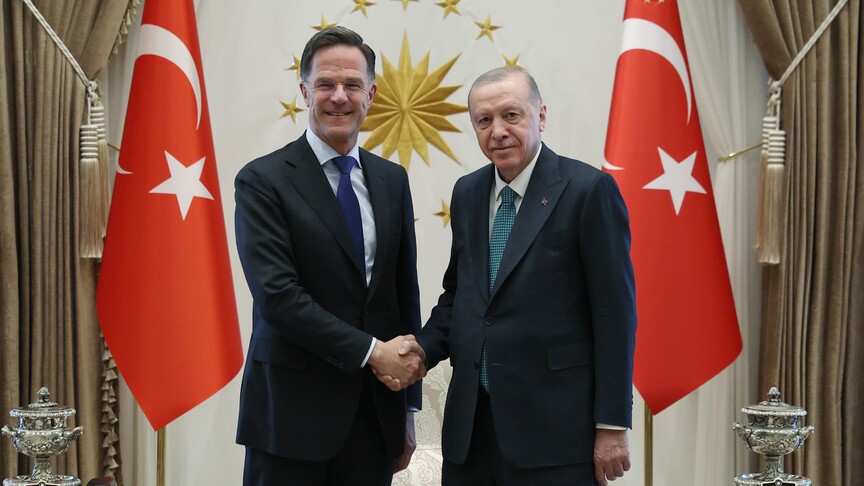
The 2026 NATO Summit will be held in Ankara on July 7-8. The meeting comes at a highly critical moment, as the alliance undergoes its most comprehensive strategic transformation since the Cold War. The most prominent of these debates is shaped around issues such as the growing visibility of the fragile structure of the European security architecture while the Russia-Ukraine war continues, the inconsistent and coercive attitude of the United States toward NATO -- which has become particularly apparent in the Greenland issue -- and assessments regarding the strengthening of Europe’s military autonomy.
Although NATO is not a global organization in structural terms, it both shapes and plays a decisive role in global affairs through its sphere of influence. Energy supply security, critical maritime passageways -- as seen in the Strait of Hormuz during the latest Iran crisis -- cybersecurity, and technological competition supported by artificial intelligence all make it necessary to redefine classical military frameworks, regardless of where these developments take place in the world.
Seen from this perspective, the Ankara Summit will be a critical summit where both NATO’s responses to current crises and the kind of strategic identity around which the alliance will be shaped in the future will be discussed.
The fact that this summit will be held in Türkiye prevents it, in terms of timing, from being considered merely a matter of hosting. Because of the Russia-Ukraine war and the still ongoing tension in Iran, Türkiye stands out within NATO for several reasons.
First, with its military-technological capacity, which has increased significantly in recent years, and with the rise of the Turkish defense industry, Türkiye now ranks among the most militarily capable countries within NATO.
Second, in a scenario in which the United States withdraws from NATO or reduces its support, the Turkish army stands as an important security partner for the European Union. Although EU countries often sacrifice this reality to the interests of countries such as Greece and Southern Cyprus, which contribute nothing to NATO, new forms of cooperation are being voiced on a state-by-state basis.
Third, the strategic deployment capability and capacity demonstrated by the Turkish armed forces in joint operations serve as confirmation of the first two points. NATO’s Steadfast Dart 2026 Exercise has been one of the examples making Türkiye’s military level visible. The ability of the Turkish armed forces to deploy joint forces to the Baltic Sea within a short period of time, to integrate different force elements under the same operational umbrella, and to carry out missions in distant geographies points to a significant capacity in terms of strategic deployment.
Finally, in terms of diplomatic contacts with crisis regions, Ankara also occupies a central place in debates on NATO’s future. Türkiye’s relations with Russia and Iran, its solid dialogue with the Gulf region and Middle Eastern countries, and its mediation activities in Africa are indicators of its diplomatic capabilities. In this sense, the fact that the NATO summit to be held in Türkiye coincides with such a conjuncture means that Türkiye’s hosting role is more than symbolic; it has the quality of a constitutive element.
NATO was born in 1949 as a collective defense organization within the hard security parameters of the bipolar international system. The founding logic of the alliance was to secure the Euro-Atlantic space militarily and politically against the Soviet threat. During the Cold War, this function was largely fulfilled. However, the collapse of the Soviet Union forced NATO to redefine its raison d’être.
In the 1990s, during the Bosnian War -- although very late -- issues such as peace support operations, crisis management, and civil-military coordination entered the alliance’s agenda. After the Sept. 11 attacks, the Afghanistan experience turned NATO’s understanding of “out-of-area” missions into an institutional reality. At the current stage, the debate is moving in the following direction: NATO must now focus on where it will conduct missions, as well as on how it will manage diversified threats within political boundaries and on what basis of legitimacy.
The current security environment has a more complex character than the challenges NATO faced in previous periods. Military attack and economic pressure, energy security and maritime transportation, cyber sabotage and social resilience, disinformation and diplomatic crisis can no longer be separated from one another. A local conflict can affect global energy prices. A regional war can disrupt supply chains. Manipulations produced in the digital sphere can weaken the political resilience of allied societies. Therefore, NATO’s future will be determined by comprehensive resilience, technological superiority, political cohesion, and strategic communication capacity, as well as an increase in military capacity.
The Russia-Ukraine war is a turning point in this regard. The war has shown how fragile Europe’s security architecture would remain without the NATO umbrella led by the United States. European countries reduced their defense spending after the Cold War, deepened their energy dependencies, and kept their military readiness levels limited; they therefore experienced a strategic shock in the face of Russia’s return to the use of hard power. This shock strengthened rearmament tendencies, accelerated efforts to increase defense industry capacity, and gave new momentum to the debates on European strategic autonomy.
Considering the security-centered developments of the last five years, Europe’s main dilemma is that although the will to establish a security architecture fully independent of the United States has increased, the military capacity to carry this goal in the short term has not yet been formed. Despite its economic size, the European Union has serious limitations in areas such as strategic deployment, ammunition production, air defense, naval power projection, and joint operational command and control.
The United States’ emphasis on burden sharing within NATO, and its discourse that at times opens the future of the alliance to debate, makes these structural inadequacies even more visible. Therefore, European security in the coming period will be shaped through a new balance among US commitments, Europe’s capacity-building efforts, and the contributions of militarily effective allies such as Türkiye.
For a long time, Türkiye was seen within the alliance as a country defined by its geographical position. For both the EU and NATO, Türkiye was described as indispensable because of its position opening onto the Black Sea, the Middle East, the Caucasus, and the Eastern Mediterranean. Yet today, Türkiye’s position for the European Union and the alliance cannot be explained only by geopolitical reality.
Despite being a neighbor to the crisis regions, Türkiye is not a security-consuming actor within NATO, but a security-provider. Moreover, years of cross-border operations, security-centered approaches in Syria, and the fight against terrorism have increased Türkiye’s field experience. This experience does not exist in Europe’s “rested armies.” In addition to all this, Türkiye’s progress in unmanned aerial vehicles (UAVs), naval platforms, electronic warfare, cyber capacity, and command-control systems has increased its effectiveness. As the future of US commitments to European security becomes increasingly debatable, Türkiye’s military capacity is becoming a more important variable in Europe’s defense equation.
Another debate that will determine NATO’s future concerns the tension between the alliance being a regional collective defense organization and the expectation that it should manage global crises. The clearest form of this debate emerged in the Israel-US and Iran war. In the end, although European countries did not join this war and clearly stated that they did not want to be involved, the security of the Strait of Hormuz, fluctuations in energy prices, and the fragility of global supply chains produced consequences that directly affected NATO members as well.
On the one hand, European countries want to maintain their distance from open-ended wars after unilateral US military moves. On the other hand, a more sensitive distinction is increasingly emerging within NATO between “allied solidarity” and “sharing political responsibility.” The main concern here is not so much NATO’s capacity to manage crises, but rather the fear that the alliance may turn into an instrument of US crisis management. In such a case, strategic autonomy efforts in Europe will grow stronger in the coming years, while political legitimacy and a shared perception of threat will gain greater importance in decision-making processes.
As a result, NATO’s future will be shaped through three main balances: to what extent the United States will sustain its leadership of the alliance; how Europe will reconcile its search for strategic autonomy with its Atlantic ties; and to what extent allies with rising military capacity, such as Türkiye, will become decisive in decision-making processes.
Türkiye is a central actor in all three of these areas of balance. This is where the real significance of the Ankara Summit lies. Türkiye is no longer merely a country protecting NATO’s borders; it is one of the constitutive actors capable of influencing the alliance’s military capacity, crisis management approach, and future strategic direction. The 2026 NATO Summit will be a historic platform that enables this reality to be seen more clearly both by Ankara and by allied capitals.
*Opinions expressed in this article are the author's own and do not necessarily reflect the editorial policy of Anadolu.
news_share_descriptionsubscription_contact

contact_the_ombudsman
is_there_an_error_in_this_story