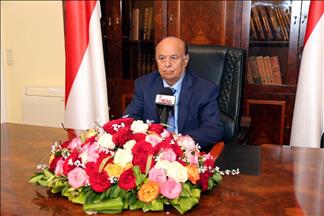
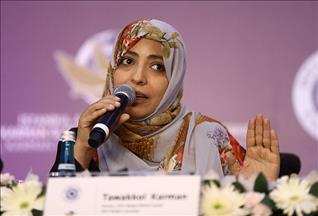
- The STC controls much of Yemen’s southern and eastern territory, while the Houthis have a grip over the most populous northern parts
- Areas controlled by Yemen’s internationally recognized government and its allied forces include a key oil and gas producing province in northeastern Yemen
ISTANBUL
The conflict in Yemen has entered a new phase as rival factions consolidate control over distinct parts of the country, raising concerns of deeper political fragmentation and de facto partition, experts say.
The latest developments come as the Southern Transitional Council (STC) has intensified and consolidated its campaign in southern and eastern Yemen, and launched a new military operation in Abyan province this week.
Yemen was unified in 1990, but political disputes in the south later fueled renewed secessionist calls, particularly after the outbreak of the current civil war in 2014.
It is currently under the effective control of multiple administrations including the Houthis, the Presidential Leadership Council (PLC), and the STC.
According to estimates by Independent Arabia, later confirmed to Anadolu by researchers, the STC currently controls around 52% of Yemen’s territory. The Houthis hold approximately 33%, while about 10% remains under the control of Yemen’s internationally recognized government and its allied forces. The remaining 5% is controlled by forces loyal to Tareq Saleh, a nephew of former President Ali Abdullah Saleh.
Below is an overview of the current territorial control in the war-torn country:
STC's grip over south and east
The STC, Yemen's main southern separatist group, claims control over almost all of the country's south and east governorates.
Earlier this month, it seized two strategically significant governorates, Hadramout and al-Mahrah, expanding control over oil fields, energy installations, a strategic coastline, and the city of Seiyun, a major urban and administrative hub.
"By attempting to expand its influence into Hadramout – the country’s largest province and a key oil-producing region – and al-Mahra, the STC appears to be seeking to consolidate military and political control over much of southern Yemen," Gamal Gasim, an associate professor of interdisciplinary studies and political science at the Grand Valley State University, told Anadolu.
The STC currently controls 52% of Yemen's territory, according to estimates by Independent Arabia.
With its eastward expansion, the STC now controls nearly all of the territory of the former South Yemen state, experts say.
"This echoes the pre-1990 period when South Yemen existed as an independent state," Gasim said.
Maysaa Shuja al-Deen, a senior researcher for Sana'a Center for Strategic Studies, also noted that the STC has assumed control of all of what was known as South Yemen before unification in 1990, which is two-thirds of the country's area.
Meanwhile, militarily, cities along Hadramout’s coast, including Mukalla and the historic port city of Ash Shihr, are controlled by the Hadramout Elite Forces, which are aligned with the STC.
Houthis dominate the north
While the STC controls much of Yemen’s territory, the Houthis have a grip over the most populous parts of the country.
Their area of influence in the country is estimated to be around 33%, according to Independent Arabia.
Gasim explained that the Houthis maintain firm control over the most populous areas in the north, including the capital Sana’a, Ibb, Dhamar, and several other northern provinces.
This includes northern and northwestern Yemen, as well as large parts of Al Hudaydah province along the Red Sea coast.
While the territory under Houthi control represents a smaller share of Yemen’s total landmass compared with the south and east, it includes the majority of the country's population, state bodies and key economic institutions.
PLC & aligned forces' limited control
Yemen’s internationally recognized government, now operating under the PLC, exercises limited and fragmented control.
According to Independent Arabia estimates, the PLC and its allied forces control around 10% of Yemen's territory.
The most significant areas under the control of its allied forces include a key oil and gas producing province in northeastern Yemen and parts in the southwest.
"Oil-rich Marib and large parts of Taiz remain under the control of anti-Houthi forces backed by the Islah party," said Gasim.
The PLC was established in 2022 and is currently chaired by Rashad al-Alimi. Government-aligned forces, many of them linked to the Islah party, retain influence over these areas.
Saleh's control of Red Sea coast
Along Yemen’s western coastline, Tareq Saleh commands forces that control parts of the Red Sea coast, including areas south of Al Hudaydah and the port city of Mokha.
Though geographically limited, these areas are strategically significant due to their proximity to the Bab al-Mandab Strait, a vital global shipping route. Saleh’s forces, also called the Yemeni National Resistance Forces, are formally aligned with the anti-Houthi coalition.
"Tareq Saleh’s forces continue to control parts of the western Red Sea coast, including the historic port city of Mokha," said Gasim.
His forces control an estimated 5% of Yemen's territory, according to Independent Arabia.
More division ahead?
Experts believe the current developments are a turning point in the conflict.
"It's a big shift in the Yemeni war. It will change many things internally and regionally, even the regional alliances now may shift," said Shuja, the senior researcher.
Gasim highlighted that Yemen is already experiencing the reality of nearly four de facto governments or political administrations, deepening the country’s political divide.
"Any attempt to formally partition the south – or any other region – would likely exacerbate both security and humanitarian crises," he said.
"Such negative political developments in Yemen are likely to have spillover effects on regional political and economic stability."