Lina Altawell
02 January 2026•Update: 02 January 2026
ISTANBUL
The Saudi ambassador to Yemen said Friday that the head of Yemen’s Southern Transitional Council (STC), Aidarus al-Al-Zubaidi, had refused to grant landing clearance to an aircraft carrying an official Saudi delegation to the southern city of Aden a day earlier.
Mohammed Al-Jaber said on the US social media platform X that Aden airport was closed Wednesday after directives issued by the STC leadership, leading to the suspension of air traffic and the cancellation of several civilian flights, including after landing clearance was denied to an aircraft carrying an official Saudi delegation scheduled to arrive in Aden on Thursday.
The diplomat warned that shutting down one of Yemen’s few operational airports represents a dangerous escalation that could complicate political and security efforts to reduce tensions and undermine coordination with regional and international partners.
He described the decision as “an irresponsible act” that “undermines political, military and security coordination,” adding that it represents “a dangerous precedent reflecting an insistence on escalation and rejection of de-escalation paths.”
He added that “those steps confirm al-Zubaidi’s keenness to prioritize personal political and financial interests,” accusing him of implementing “agendas that have no relation to the Southern (secessionist) cause in particular, nor to Yemen in general.”
On Thursday, the STC announced the suspension of operations at Aden International Airport, the main air gateway for Yemeni areas outside Houthi control, which operates flights to destinations including Saudi Arabia, Egypt, and Jordan.
Al-Jaber said that al-Zubaidi had taken “unilateral decisions” inconsistent with his political obligations as a member of Yemen’s Presidential Leadership Council, including leading a military attack targeting Hadhramaut and Mahra, which he said resulted in “security breakdowns and civilian casualties.”
The Saudi envoy reiterated that the kingdom “has supported and continues to support the Southern cause as a just issue,” stressing that its resolution “must come through political dialogue.”
Hadhramaut’s local authority condemned the STC’s move in a Facebook statement, describing it as “unprecedented escalation” and “a clear declaration of rejecting the option of peace and political dialogue that the Kingdom seeks to entrench.”
The move, it added, underscores an insistence on military escalation and threatens stability in Hadhramaut and Al-Mahra provinces.
According to the statement, the Saudi delegation carried a de-escalation proposal aimed at preventing bloodshed, avoiding the consequences of armed conflict, arranging the withdrawal of forces from military camps in Hadhramaut and Mahra and handing them over to government-aligned Nation’s Shield Forces, while prioritizing political dialogue as the sole path to resolving the southern issue in line with public aspirations.
The local authority described obstructing Saudi mediation as “an irresponsible act that serves narrow agendas” and seeks to drag relatively stable provinces into security chaos that has previously resulted in civilian deaths and injuries.
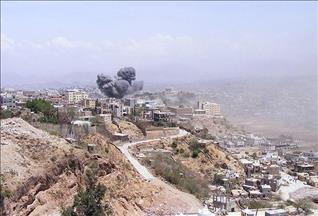
Yemen has seen an unprecedented escalation since Tuesday after STC forces took control of Hadhramaut and Al-Mahra in early December. The two provinces account for nearly half of Yemen’s territory and share borders with Saudi Arabia.
Saudi Arabia accused the United Arab Emirates (UAE) the same day of “pushing STC forces to carry out military operations” along the kingdom’s southern border in Hadramaut and Al-Mahra. Abu Dhabi denied the accusation.
Tensions escalated further after the Saudi-led coalition carried out an airstrike that targeted what it said were weapons that had arrived at the port of Mukalla in Hadhramaut, which is under STC control, aboard two ships coming from the UAE’s Fujairah port.
The UAE later said the weapons were designated exclusively for its forces and announced the end of the mission of its “counterterrorism teams in Yemen,” noting that it had ended its military presence within the coalition in 2019.
The STC says successive Yemeni governments have marginalized southern regions politically and economically and calls for secession. Yemeni authorities reject the claim and reaffirm their commitment to the country’s unity.