WASHINGTON/ISTANBUL
Recent demonstrations in Iran and evolving negotiations between Tehran and Washington reflect a complex dynamic in which both sides are preparing for potential confrontation while simultaneously seeking to avoid war, according to Middle East analyst and academic Vali Nasr.
In an exclusive interview assessing the latest developments, Nasr told Anadolu that the protests that erupted in Iran were an enormous difference from previous waves of unrest, both in scale and political demands.
“I think the demonstrations we saw in Iran are different in two major ways. First is that the size, the scope, (and) the intensity of the protests was perhaps one of the largest that Iran has encountered since the 1979 revolution. And the protests were very, very clearly asking for an end to the Islamic Republic,” he said, adding that the demonstrations moved beyond economic grievances toward overt calls for regime change.
Nasr also highlighted a second distinguishing factor: unprecedented external political pressure accompanying the unrest.
According to him, exile groups, often backed by Israel and the US, encouraged mass mobilization, while US President Donald Trump, “for the first time for an American president, threatened to intervene militarily to support the protesters so that they can bring about regime change.”
- War rhetoric paired with diplomatic signals
Despite early threats, Nasr argued that Washington’s recent actions suggest a preference for diplomacy over direct military escalation. He pointed to a period of heightened tension roughly two weeks earlier when Iran reportedly closed its airspace amid expectations of an imminent strike.
“The very fact that there was a window of opportunity about two weeks ago, where even Iranians closed their airspace, it was an expectation of an attack, he didn't do it,” Nasr said, referring to Trump.
Instead, he noted, Washington began engaging regional actors, including Türkiye, Saudi Arabia, Qatar, Oman, and Egypt, to establish a negotiating framework.
“This was largely led in major ways by Türkiye and its foreign minister and its president,” he said, describing how diplomatic efforts initially led to plans for talks in Istanbul before the venue shifted to Moscow for various reasons.
The location change, he added, is less significant than the broader diplomatic architecture that emerged during earlier discussions involving Ankara.
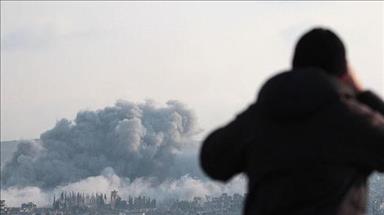
Nasr argued that both Iran and the US are leveraging the threat of military action as a negotiating tool.
“Both Iran and the US are preparing for war, but they don't want to go to war,” he said, noting that Washington’s deployment of military assets functions as pressure while Tehran seeks to deter escalation by signaling the potential costs of conflict.
- Different approach from past US wars
Comparing the current moment to US policy toward Iraq under Presidents George H.W. Bush and George W. Bush, Nasr suggested Trump’s strategy differs in intent.
“The negotiations were basically only there to, sort of, (act) as a step towards war… Whereas I think President Trump, seriously, is trying to avoid war,” he said, while acknowledging the president’s unpredictability.
Iranian leaders, he added, initially assumed Washington sought to avoid conflict, yet their distrust deepened after Trump allegedly gave Israel a “green light” for strikes and authorized limited bombing of Iranian nuclear facilities.
“But again, you know, the lesson the Iranians learned is (that) he only bombed Iran for 45 minutes. And then very quickly he asked for a ceasefire,” Nasr said, describing a pattern that has increased suspicion on both sides.
- Lower expectations for negotiations
According to Nasr, Tehran’s goals in current negotiations differ sharply from those during the 2015 nuclear talks. At that time, Iranian officials viewed diplomacy as a pathway to economic reintegration and development.
“I think now they're looking to an agreement in Moscow just to avoid war. Their expectations are much, much lower,” he said.
He added that Iranian authorities increasingly believe Washington’s ultimate objective is regime change rather than a sustainable nuclear agreement. As a result, Tehran may treat any deal more as an interim ceasefire than a transformative diplomatic breakthrough.
“This is much more like an interim ceasefire deal with the US,” Nasr said, emphasizing that Iranian leaders do not expect a future agreement to significantly reduce long-term threats against the country.
- Strategic leverage and nuclear questions
Nasr argued that both sides still retain bargaining leverage. Iranian leaders believe that Trump fears a “messy war,” which could serve as a deterrent against full-scale military action, he added.
“It’s kind of like, yes, I know you can destroy me, but I can also cut you multiple times before I get destroyed,” he said, describing Iran’s strategic mindset.
He also questioned claims that Iran’s nuclear program has been fully dismantled, noting that negotiations continue over sensitive issues such as enriched uranium stockpiles, International Atomic Energy Agency access, and limits on future enrichment.
“If he wants to talk about it, that automatically means that Iranians have something to talk about,” Nasr said, referring to reported discussions about approximately 881 pounds (400 kilograms) of uranium enriched to 60%.
Additional contentious topics include Iran’s support for regional proxy groups, such as the Houthis and Hezbollah, and the future of its ballistic missile program, which Nasr described as Israel’s primary security concern.
While Tehran is unlikely to abandon missile capabilities entirely, he suggested it could consider restrictions on deployment or range as part of a negotiated compromise.