

Gaza flood was 'utterly preventable tragedy,' says Amnesty International
'Devastation and deaths caused by the storm in Gaza provide yet another wakeup call to the international community,' says Erika Guevara Rosas, Amnesty official
LONDON
Devastation and suffering from heavy rainfall and storms that hit Gaza are the foreseeable consequences of Israel’s ongoing genocide and were an "utterly preventable tragedy," Amnesty International said Wednesday.
In a statement, the international human rights group said the devastating scenes of flooded tents and collapsed buildings in Gaza that have emerged in recent days "cannot be blamed solely on bad weather."
"They are the foreseeable consequences of Israel’s ongoing genocide and deliberate policy of blocking the entry of shelter and repair materials for the displaced," said Erika Guevara Rosas, Amnesty International’s senior director for research, advocacy, policy, and campaigns.
Stressing how Israel has only allowed extremely limited supplies to reach the enclave’s people, the statement said this is further indication that Israeli authorities are continuing to “deliberately inflict on Palestinians in Gaza conditions of life calculated to bring about their physical destruction – an act prohibited under the Genocide Convention, an act prohibited under the Genocide Convention.”
"The devastation and deaths caused by the storm in Gaza provide yet another wakeup call to the international community, paid for with the lives of people who had managed to survive two years of Israel’s ongoing genocide," underlined Rosas.
She called on the international community to urgently enable Gaza to prepare for the severe winter conditions by pressing Israel to end the blockade on Gaza and lift all restrictions on the entry of life-saving supplies, including shelter materials, nutritious food, and medical aid.
The statement stressed that after multiple displacements, destruction of or damage to at least 81% of structures, and the designation of nearly 58% of Gaza’s total area as no-go zones, the overwhelming majority of Palestinians are now living in dilapidated tents or damaged shelters.
"I still cannot digest the thought that we survived the bombardment only for my children to be crushed as a result of the storm," Mohammed Nassar, the father of Lina and Ghazi, who died after their severely damaged home collapsed, was quoted by the statement as saying.
Lina, 18, and Ghazi, 15, died when their severely damaged home in Sheikh Radwan collapsed on Dec. 12 following the storms.
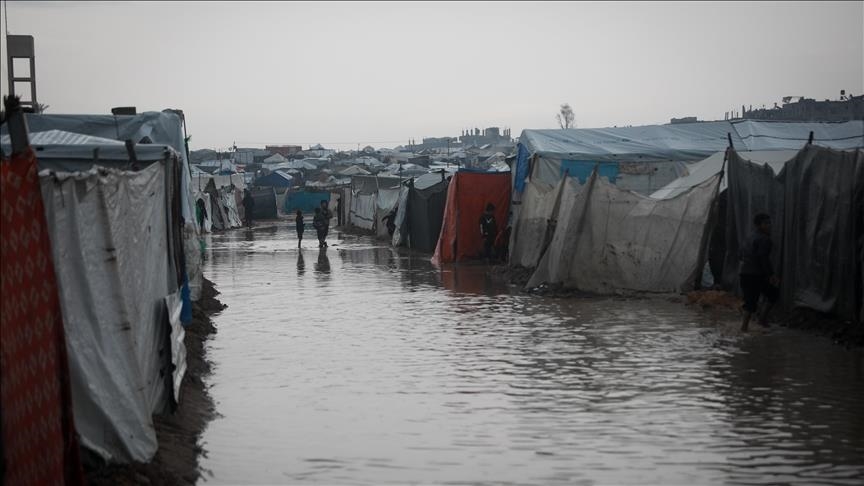
Thousands of tents turned into pools of water
On Wednesday, the UN agency for Palestinian refugees (UNRWA) warned that Storm Byron has further aggravated the already dire living conditions for thousands of displaced people in the Gaza Strip, many of whom are sheltering in tents or damaged buildings.
Since last week, thousands of tents housing survivors of Israel’s war have turned into pools of water, soaking bedding, clothing, and food supplies, and leaving hundreds of Palestinian families exposed to the cold without warmth or shelter.
The Gaza Strip, the media office said, needs around 300,000 tents and prefabricated housing units to meet the most basic shelter needs of Palestinians after the destruction of the enclave’s infrastructure in two years of Israeli attacks.
Israel's two-year war in Gaza killed more than 70,000 Palestinians and decimated the enclave. The assault was supposed to come to a halt under a fragile ceasefire deal that took effect in October.
However, Palestinians accuse Israel of repeatedly violating the Gaza ceasefire agreement. At least 393 people have been killed and 1,074 others injured in Israeli attacks since the ceasefire, according to the Gaza Health Ministry.
Israeli Prime Minister is wanted by the International Criminal Court for war crimes and crimes against humanity in Gaza. This week, the appeals chamber of the ICC rejected Israel’s legal challenge seeking to block an investigation into its actions in the genocidal war in the Palestinian territory.
Related topics


Russia accuses Ukraine of timing oil cutoff to interfere in upcoming Hungary polls
Trump's NATO withdrawal threat: Senate minority leader hails Rubio's previous stance, making Senate approval a must
Morning Briefing: April 2, 2026
Turkish Republic of Northern Cyprus president condemns attack on citizens by groups from Greek Cypriot Administration
UN Security Council condemns Israeli attacks on UNIFIL in Lebanon



