COTABATO, the Philippines
A few young girls wearing headscarves look down from the second floor of their orphanage at 3 a.m. on the island of Mindanao in the Philippines.
Rubbing their eyes, they have just woken up to start their fasting after attending the sahur meal and morning prayer.
With about 10,000 orphans living under harsh conditions across the island after decades of warfare, these girls are among a lucky few.
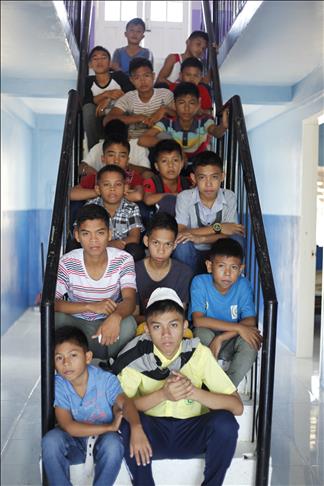
Living at the Hacı Serefoglu orphanage run by Turkish NGO the Humanitarian Relief Foundation (IHH) , the girls enjoy a sahur meal during the month of Ramadan which includes bananas, rice and fish prepared by cooks who also serve in the orphanage and clean.
Opened in 2011, the foundation provides a home for 40 children located only couple of kilometers from Cotabato City in the south part of Mindanao, which has a 20 million-strong population.
- 'Orphans of war'
And yet the orphanage is not even able to accommodate one percent of the orphans on the island.
Most of the poor populated neighborhoods in Cotabato City contain hundreds of orphans, living without clean water and electricity.
The number of parentless children on Mindanao island mushroomed dramatically after armed conflict broke out against the Philippines government more than 40 years ago, leading to the deaths of more than one hundred thousand people.
"Most of the children became orphans due to war, and also lack of medical support which was needed to try and prevent disease," said Omer Kesmen from the IHH, who is also chair of the orphanage and has become referred to as "father" by the children there.
Bayhairan Gazali, 13, who never knew her father as he was killed during the war three months before she was born, says: “I like the friendly environment here, and I'm pleased to be supported while I continue my education."
Muhacir, 12, lost his father when he was only seven years old and his mother suffered psychological problems and disowned him.
But he said he was "hopeful for the future", adding that he "wants to be an engineer".
- Significant presence
Maleeha, 11, said she likes the fact that she is able to live in a big house, compared to many of her classmates in public school.
Parts of southwestern Mindanao, where the Bangsomoro people are living, is home to a sizeable Muslim population, making the island the only area of the Philippines with a significant Muslim presence.
Since the 1970s, the Moro Islamic Liberation Front (MILF) and several other armed groups supported a rebellion aimed at achieving independence for the country’s predominantly Muslim south, determined to earn what their leaders term "a better life" for the predominantly Catholic country's Muslim population.
The President of the Philippines, Benigno Aquino, and the MILF signed a preliminary peace agreement in March 2014, representing the culmination of diplomatic efforts aimed at ending the conflict in Mindanao.
At least 120,000 people, mostly civilians, were killed during the decades of violence, which has also left large parts of the country’s fertile southern region mired in poverty.
http://www.aa.com.tr/en