By Tuncay Kayaoglu
ISTANBUL
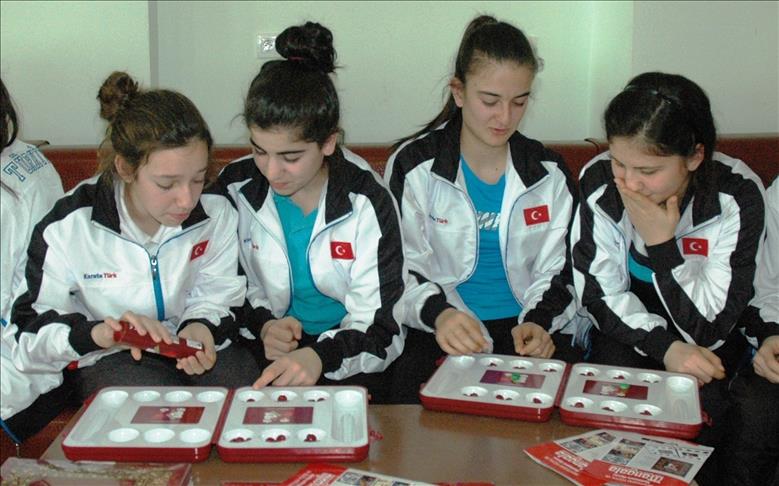
Adem Yerlikaya, a 13-year-old student from Istanbul, has been playing 'Mangala,' a strategic counting game, for a year. His friend, Furkan Aslan, has been playing the game for almost seven months. The two friends participated in a two-day tournament in Istanbul, competing with two hundred rivals from other schools. The winner will play in Turkey’s 'Mangala' championship scheduled for next week. The winner will win a weeklong tour to Central Asia, the ancestral homeland of Turks, which some Turks believe is also the origin for the game of 'Mangala.'
This long-forgotten game, regarded by some as a traditional Turkish game, has been revived in Turkish schools thanks to tireless efforts by brothers Serkan and Serdar Ceyhan. This began when the brothers noticed an Ottoman miniature, a detail of which depicted the game, and the brothers made it their life mission to revive the game.
"In a miniature depicting a circumcision festival for Mehmet, the son of the Ottoman Sultan Suleiman the Magnificent, we noticed that two men were playing a game. We discovered that the game is ‘Mangala’. We could have ignored it, but we chose to try to spread it. In 2008, only three people knew this game, and now around one million people are aware of this counting game," a proud Serkan Ceyhan told The Anadolu Agency.
The last seven years of getting the game produced were not easy. When Serkan first encountered the game with his little brother Serdar, they created a sample game board which they distributed to around 2,000 prominent people in Turkey, hoping that the game would catch on.
They were disappointed: "Only seven people sent a thank-you note. Yet this disappointing response only motivated us further. We started telling more people about this game." To their luck, ‘Mangala’ made an appearance in 'The Magnificent Century,' a popular historical Turkish soap opera television series set in the era of Suleiman the Magnificent, and this gave the brothers the extra nudge to carry the game into development.
The Ceyhan brothers contacted various Turkish government ministries to see if anyone would be interested in helping them to popularize the game amongst the Turkish public.
"For four months, I held talks with officials from the Tourism Ministry. Eventually, the ministry created a committee to evaluate our claims and they finally approved our application. The Ministry of Education has recommended the game of ‘Mangala’ to schools. These steps opened our way," Serkan said.
With official approval, the Ceyhan brothers started touring the country to teach the game. They shot a documentary that will be shown at schools next year. In a bid to popularize the game globally, the brothers gave a game set to former World Chess Champion Garry Kasparov. "Kasparov was surprised to see the Mangala game," Serkan said.
'Mangala' is considered by a few Turks as a game of their ancestors. The Turkish Ministry of Tourism labeled the game as part of "Turkey’s cultural treasury" and the Ministry of Education has promoted it as a Turkish game. Yet the game’s origin is contested.
Some studies have shown that ‘Mangala’-like games can be found from Africa to Asia, and has even been found on some Pacific islands. More than 800 types of traditional ‘Mangala’-like games are known. Many of these games share commonalities in general game play.
The Turkish game is played by two people with a board consisting of 12 small pits arranged in two parallel rows, with six pits in each row. Each player has one treasury where he is going to collect his pieces. Players distribute the 48 game pieces in a way that each pit has 4 pieces. The aim of each player is to collect as many pieces as they can in their treasuries. The winner of each game set is the one who has the most number of pieces in their treasury at the end of the game.
The Ceyhan brothers assert that 'Mangala' originated in Anatolia and thus belongs to Turkish history. Serkan says in reference to the game, "We have seen stones with hallmarks of this game in Gobekli Tepe, an archaeological site in Turkey’s southeastern town of Sanliurfa which dates back to 10,000 BC. Similar stones also have been unearthed in Gaziantep and Mersin." (Gaziantep and Mersin are towns in southern Turkey.) Bristling at the suggestion that the game originated in Africa, Serkan responds, "This claim was proven false in 1979."
The Ceyhan brothers want more people to play the game and hope to create a federation in Turkey, as well as organize an international tournament in the future.
www.aa.com.tr/en