LAGOS
Experts suggested on Tuesday that Nigeria had ignored early warnings about Ebola the same way it had ignored early warnings about the Boko Haram insurgency.
"We got early warnings about Ebola being a biological weapon to be directed at Nigeria," Dr. Ona Ekhomu, head of the Association of Industrial Security and Safety Operators of Nigeria, told Anadolu Agency on the sidelines of a two-day security conference in Lagos.
"I am aware of memos upon memos written on this, but this was ignored," he suggested. "The warnings were ignored as usual, and here we are battling the virus."
The two-day conference was held under the banner "Security in Nigeria during the Centennial Year," with at least eight speakers lined up to discuss various topics.
Ekhomu urged the authorities to treat Ebola as a biological security threat directed at Nigeria.
"Treating it merely as a medical or health issue just does not cut it," he said.
Claims that Ebola is a biological weapon are a fresh development in national discourse on the virus, according to an AA correspondent.
On Monday, a U.S. federal air marshal was allegedly injected with a syringe containing an as-yet-unidentified substance at Lagos international airport.
The air marshal has been quarantined in Houston, Texas, due to fears he might have been injected with Ebola, according to media reports.
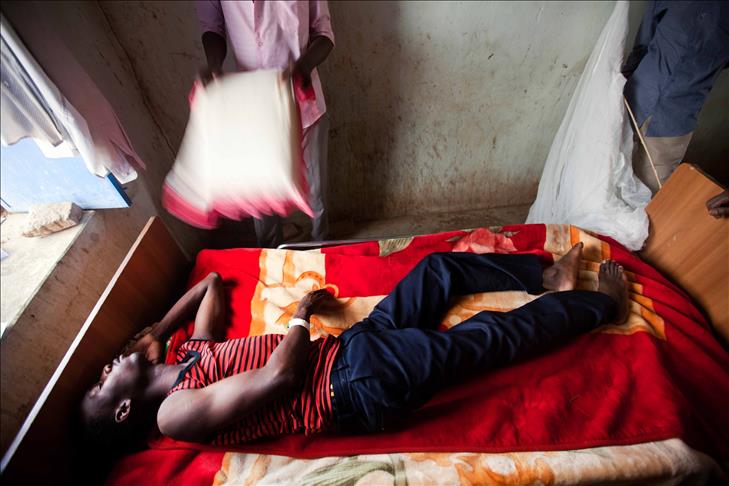
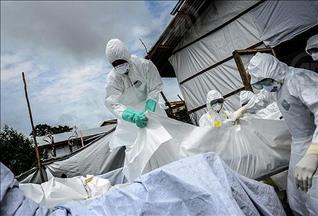
In recent months, Ebola – a contagious disease for which there is no known treatment or cure – has claimed more than 2,000 lives in West Africa, mostly in Sierra Leone, Guinea and Liberia.
Nigeria, meanwhile, has confirmed seven Ebola deaths.
The virus reached Africa's most populous country through Patrick Sawyer, a Liberian national who flew to Nigeria on July 20 from Monrovia. He died four days later in Lagos.
The tropical fever, which first appeared in 1976 in Sudan and the Democratic Republic of Congo, can be transmitted to humans from wild animals.
It also reportedly spreads through contact with the body fluids of infected persons or of those who have died of the disease.
Same mistake
Prof. Omololu Soyombo, a leading Nigerian expert on deviant youth behavior, said Nigeria was prone to crime because of mass poverty, porous borders, unemployment and a lack of access to basic needs.
"We ignored all warnings that Boko Haram was going to become a huge problem," he said. "At its very infancy, we ignored the warnings."
"To address this crisis, we must begin to address the question of poverty, unemployment, porous borders, poor security structures, inequity and injustice and religious intolerance," Soyombo asserted.
"Northeast and southeast [Nigeria] had the least allocation of resources since 1960, and so poverty is touchable in the north," he noted.
The professor said terrorism in Nigeria was also driven by "the long-term abuse of human rights by security agencies," along with "poor governance, the proliferation of arms and religious intolerance."
"Nigeria must avoid replication of Boko Haram elsewhere in the country. The replication is very possible when you look at the insecurity elsewhere in the country," he cautioned.
Dele Ezeoba, a former chief-of-naval-staff, called for better information gathering and sharing among different countries.
"That is, each member state identifying their area of strength and working to support one another for better security," he said.
Boko Haram has already overrun the towns of Dikwa, Gamboru Ngala, Gwoza and Bama in Nigeria's northeastern Borno State.
Maiduguri, the densely populated provincial capital of Borno and the state's most populous city, appears to be the militants' primary objective.
Boko Haram also now controls Buni Yadi and Bara in the neighboring Yobe State.
The group is also said to have captured eight towns in Adamawa State, which has a population of some 2.5 million.
Boko Haram's elusive leader, Abubakar Shekau, recently declared all territories under the group's control to be part of an "Islamic caliphate" in northern Nigeria.
Since May of last year, all three states – Borno, Yobe and Adamawa – have remained in a state of emergency imposed by the government with the stated aim of curbing the Boko Haram menace.
www.aa.com.tr/en