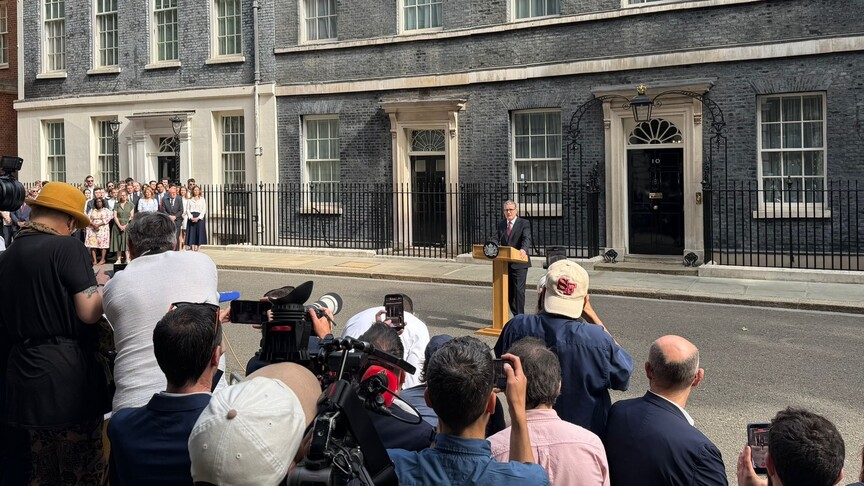
Britain is preparing for its seventh prime minister in 10 years after Keir Starmer announced he would step down once the Labour Party selects a successor.
Less than two years ago, Starmer entered Downing Street with a landslide election victory and a promise to restore stability after years of Conservative turmoil.
"We said we would end the chaos and we will," Starmer declared in 2024.
Since 2016, the occupants of Number 10 have changed almost as frequently as the political crises confronting them.
David Cameron, Theresa May, Boris Johnson, Liz Truss, Rishi Sunak, and Starmer have each taken their turn, and Britain is now preparing for prime minister number seven in just 10 years.
Yet, the contrast with previous decades is striking. Between 1979 and 2016, Britain had just five prime ministers: Margaret Thatcher, John Major, Tony Blair, Gordon Brown and David Cameron. Together, they governed for nearly four decades.
Here is how the UK's revolving door of leadership kept spinning:
David Cameron served as prime minister from 2010 to 2016, first in coalition with the Liberal Democrats and then with a Conservative majority.
For much of his premiership, Cameron was regarded by allies as a politically fortunate leader, having returned the Conservatives to government and secured an outright majority in 2015. That reputation, however, did not survive the Brexit referendum.
His premiership ended after the June 2016 vote, when Britain chose to leave the EU. Cameron had campaigned for the UK to remain in the bloc.
The "Leave" campaign won 51.9% of the vote on a turnout of 72%.
He resigned the morning after the referendum, becoming the first prime minister to fall in the turbulent post-Brexit era.
Theresa May took office in July 2016, inheriting the task of delivering Brexit.
She triggered Article 50 in March 2017, formally starting the withdrawal process, and called a snap election that year to strengthen her position. The plan backfired: the Conservatives lost their majority and had to rely on Northern Ireland’s Democratic Unionist Party.
May spent much of her premiership trying to pass a Brexit withdrawal agreement. Parliament rejected her deal three times, while pro-Brexit and pro-EU factions both accused her of failure.
After the Conservatives suffered heavy losses in the 2019 European Parliament elections, May announced her resignation.
May said she had done "everything I can" to convince MPs to support the withdrawal deal, and said it will be better for the country to lead with another prime minister.
Boris Johnson entered Downing Street in 2019 promising to "get Brexit done" and quickly delivered the Conservatives their largest parliamentary majority since the 1980s.
But his premiership was quickly overtaken by the COVID-19 pandemic and later by a series of scandals.
The most damaging was “Partygate,” involving gatherings in government buildings during lockdown restrictions.
Johnson repeatedly denied knowingly breaking the rules and insisted he had acted in good faith.
Yet, he survived one no-confidence vote, but within days, dozens of ministers and government officials resigned from their posts, arguing that they could no longer support Johnson's leadership.
On July 7, 2022, Johnson finally announced his resignation as Conservative Party leader.
Liz Truss became prime minister in September 2022, promising to boost economic growth through tax cuts and deregulation at a time of soaring inflation and rising energy costs.
Her premiership quickly ran into trouble after she and then-Treasury chief Kwasi Kwarteng unveiled a package of unfunded tax cuts known as the "mini-budget."
The plan triggered turmoil in financial markets, sending the pound to a record low against the US dollar and causing government borrowing costs to surge. The Bank of England was forced to intervene to stabilize markets.
As pressure mounted, Truss abandoned key parts of her economic agenda and dismissed Kwarteng.
Facing growing unrest among Conservative lawmakers, Truss announced her resignation in October 2022.
"I recognise that I cannot deliver the mandate on which I was elected by the Conservative Party," she said.
After just 45 days in office, Truss became the shortest-serving prime minister in British history.
Rishi Sunak became prime minister in October 2022 after Truss stepped down.
He promised stability and competence, trying to rebuild economic credibility and calm a Conservative Party exhausted by infighting.
Sunak set out priorities, including lowering inflation, growing the economy, cutting debt, reducing National Health Service waiting lists and stopping small-boat crossings.
But after 14 years of Conservative rule, the party remained deeply unpopular. Cost-of-living pressures, public service strains and internal divisions continued to weigh on the government.
Sunak called a general election in 2024 and lost heavily to Labour, ending Conservative rule and bringing Starmer to power.
Starmer's victory was supposed to mark a turning point.
Having rebuilt Labour after its crushing 2019 defeat, he entered office with a huge parliamentary majority and a promise to restore trust in government.
But the challenges proved larger than many expected.
Economic pressures persisted, Labour's popularity steadily declined and Nigel Farage's Reform UK emerged as a growing political force.
By early 2025, Reform had overtaken Labour in some opinion polls.
A rebellion over welfare cuts forced Starmer into a humiliating U-turn, while a series of ministerial resignations raised fresh doubts about his authority.
Heavy losses in local elections this year deepened concerns among Labour lawmakers that Starmer could no longer lead the party into the next general election.
In his resignation speech, Starmer acknowledged that reality.
"The question my party is asking now is whether I am best placed to lead us into the next general election," he said.
"I have heard the answer."
Starmer will remain prime minister until Labour selects a new leader.
The party's National Executive Committee is expected to open nominations on July 9. Candidates must secure the backing of at least one-fifth of Labour lawmakers before seeking support from local party organizations and affiliated groups.
If only one candidate qualifies, a successor could be confirmed as early as mid-July. A contested race, however, could extend into September.
Former Greater Manchester Mayor Andy Burnham is widely viewed as the frontrunner after confirming his candidacy.
He has already secured the backing of former Health Secretary Wes Streeting, while other potential contenders include former Deputy Prime Minister Angela Rayner and former Armed Forces Minister Al Carns.
Because Labour retains a comfortable majority in the House of Commons, the leadership transition will not automatically trigger a general election. Once a new leader is chosen, King Charles III will invite them to form a government and become Britain's next prime minister.
news_share_descriptionsubscription_contact

contact_the_ombudsman
is_there_an_error_in_this_story