By Andrew Jay Rosenbaum
ANKARA
Businessmen in Kiev say it's becoming tougher to make a living in Ukraine amid the country's economic strife and ongoing conflict in the east.
Maksym Gapchuk, the chief financial officer at an Austrian insurance group in the Ukrainian capital of Kiev, told The Anadolu Agency: "Practically every business, of every kind, is suffering.
"Every business is affected by the devalued hryvnia, and also by the overall decline in demand."
“Overall, businesses are losing money, and there seems to be no end to losses," complained Sergiy Shchukin, who runs a leisure and travel business in the city.
And they are not alone.
- Bank protest
About 30 people demonstrated outside the National Bank of Ukraine's headquarters on Instytutska Street on Feb. 13 in protest against the devaluation of the hryvnia as the currency reached an all-time low of 26 against the U.S. dollar.
Gapchuk said: "The biggest slide for the hryvnia happened in January. The hryvnia exchange rate to the dollar fell to 35.
"For some businesses where the share of import positions was more than 50 percent, businesses stopped being profitable at a rate of 20 to the dollar."
Currently at 24 to the dollar, the amount of hryvnia people need to buy food in Kiev is formidable with food price inflation at just over 30 percent in January, according to U.S. Department of Agriculture statistics.
And with additional costs being added to consumer purchases through devaluation, the Ukrainian government is now taxing imports at between five and 10 percent.
- Unaffordable heating
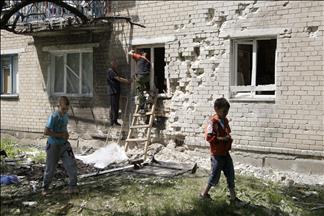
Kiev's eight-month-old war with pro-Russian separatists costs $5 million a day as Ukrainians face the mounting hardships of winter with energy subsidies that had made home heating affordable have now been cancelled.
"The war doesn't have a direct influence on our daily lives," Gapchuk said. "The problem is that, in one year, all of us have become much poorer -- and there’s no end in sight."
Shchukin added: "A recent report from the Kiev-based think tank the Razumkov Center showed wages are not increasing, while inflation was at about 25 percent.
"People either don’t spend, or they spend all the hryvnia they have to buy goods before the prices go up again."
"A vast number of consumers have been thrown below the poverty level while the rest are coping with losses from their businesses and/or are preparing to emigrate," Shchukin added.
- Suffering business
For his leisure industry businesses, Shchukin said that times have been bad since the crisis of 2008 and even during the so-called "golden 2000s."
He warned the coming year will see yet another drop in travel abroad.
"Even established restaurants in Kiev have been losing money," Shchukin pointed out.
Shchukin has suffered particularly because his business had interests in Crimea which were confiscated by Russians after the Russian Federation annexed the region.
He said: "We have, however, gone to court successfully and recovered these interests -- but we had to go to a Russian court!"
- 'High bad debt'
Further pressure on businesses comes from the decline in trade with Russia, which was Ukraine’s largest trading partner until the conflict started.
Russia continued last year to be the biggest trade partner for Ukraine with a bilateral trade volume of $22.4 billion compared with $38.2 billion in 2013, according to the State Statistics Service of Ukraine.
"The banks are doing very badly, of course," Shchukin said.
"The National Bank introduced strict limits on taking away hard currency deposits and purchasing hard currency, but deposits are leaving the banking system in billions of dollars while the percentage of bad debt is very high," he explained.
"The National Bank has had to close down or introduce a temporary administration in dozens of banks. Most of them are small ones, but even larger banks have difficulties serving their obligations," he said.
- 'Point of no return'
What is needed is reform, business people say.
Ihor Burakovskiy, director of the Institute for Economic Research and Policy Consulting, said in a recent interview: "Ukraine is very close to the point of no return. We desperately need reforms, they are demanded in society.
"The modern Ukrainian model of governance and economic development has no future."
"There is tension because of the conflict in the east, but people understand that we must stand up for the reforms," he said.
The Ukrainian parliament has just passed the 2015 budget which includes a slate of reforms, but these are not the ones businesspeople want, Shchukin complains, saying it is about raising money in the budget for the International Monetary Fund program.
He pointed out: "The need to raise budget revenues which, coupled with the government's inability to cut spending and stop large-scale syphoning of budget resources through corruption schemes, have resulted in huge deficits which are being covered by the printing press at the National Bank.
"This practice naturally leads to a falling hryvnia, which in turn puts businesses in a more difficult situation, thus launching a vicious circle."