Global markets are still under selling pressure due to the lack of any tangible progress on a potential ceasefire between the US and Iran and the continued effective closure of the Strait of Hormuz.
US President Donald Trump said he ordered the US Navy to strike any vessel laying mines in the strait while saying he ordered the navy to triple the mine-clearing operations in the vital waterway.
Israeli Defense Minister Israel Katz said that they are waiting for the US approval to launch new attacks on Iran.
Tehran's air defense systems are reportedly activated, raising market concerns.
The Strait of Hormuz remains effectively closed due to a lack of tangible progress toward restarting negotiations to de-escalate tensions, driving oil prices higher amid selling pressure.
Uncertainty over whether the US–Iran tensions will escalate or subside is prompting investors to remain cautious, while oil prices are expected to remain high if risks in the waterway persist, which could put even more pressure on global economic growth.
Companies are generally reporting strong earnings this season with sharp rises in semiconductor stocks.
As for the macroeconomic side, the US’ initial jobless claims rose 6,000 from the previous week, reaching 214,000 in the week ending April 18, above market estimates.
The US’ manufacturing Purchasing Managers’ Index (PMI) climbed to 54 in April, its highest since May 2022, while the services PMI rose to 51.3 in the same period, showing recovery, and the composite PMI reached 52.
The US 10-Year Treasury yield reached 4.32%, and the US Dollar Index climbed 0.1% to 98.9 due to waning hopes of de-escalation in the Middle East, while the June futures price for Brent crude oil reached $105 per barrel, up 0.6%, and gold hit $4,674 per ounce, down 0.4%.
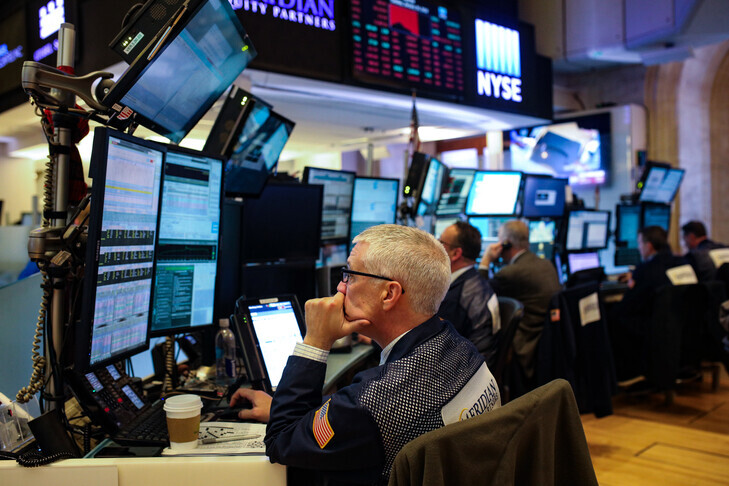
The New York Stock Exchange closed Thursday lower due to these developments.
Despite Tesla’s rising revenue and profits in the first quarter, its shares fell 3.6% after the electric vehicle (EV) maker raised its annual spending plan to over $25 billion.
US tech firm IBM’s shares declined 8.3% despite its revenue and profits exceeding expectations in the first quarter.
American defense contractor Lockheed Martin’s shares declined 4.6% after a decline in the firm’s first-quarter profits.
Tech firm Texas Instruments’ shares rose 19.4% following its first-quarter results exceeding estimates.
US chipmaker Intel’s revenue climbed 7% year-on-year in the first quarter while its shares surged 21%.
The Dow Jones fell 0.36%, the S&P 500 0.41%, and the Nasdaq 0.89% on Thursday, while American indexes started Friday mixed.
As for Europe, a mixed trend came to the fore on Thursday amid Middle East tensions.
The eurozone’s manufacturing PMI for April reached 52.2, above estimates, while the same figure for Germany was 51.2, below estimates.
Finnish firm Nokia’s shares rose 6.4% after it reported its first quarter profits surged 54%, exceeding expectations.
Cosmetics firm L’Oreal’s shares gained 9% following its fastest sales growth in two years.
The CAC 40 index gained 0.87% and the FTSE MIB 30 0.26%, while the FTSE 100 and the DAX 40 fell 0.19 and 0.16%, respectively, on Thursday. European indexes started Friday mixed.
In Asia, stock markets traded mostly low due to the lack of positive developments in peace talks.
Rising oil prices and the loss of momentum in tech stocks in the region contributed to the selling pressure.
Japan’s consumer price index (CPI) rose 1.5% on an annual basis in March, above estimates, while its core CPI climbed 1.8%, above expectations and rising for the first time in five months.
The country’s inflation still remains below the 2% target of the Bank of Japan (BoJ).
The Nikkei 225 gained 0.6%, while the Shanghai Composite Index fell 0.6%, the Kospi 0.1%, and the Hang Seng Index 0.2% near the close.
*Writing by Emir Yildirim