Hazel Belkis Belge
16 May 2026•Update: 16 May 2026
Archaeologists at the ancient city of Pompeii Archaeological Park in southern Italy have identified one of the victims of the eruption of Mount Vesuvius in 79 AD as a doctor after advanced diagnostic examinations revealed surgical instruments hidden inside a plaster cast.
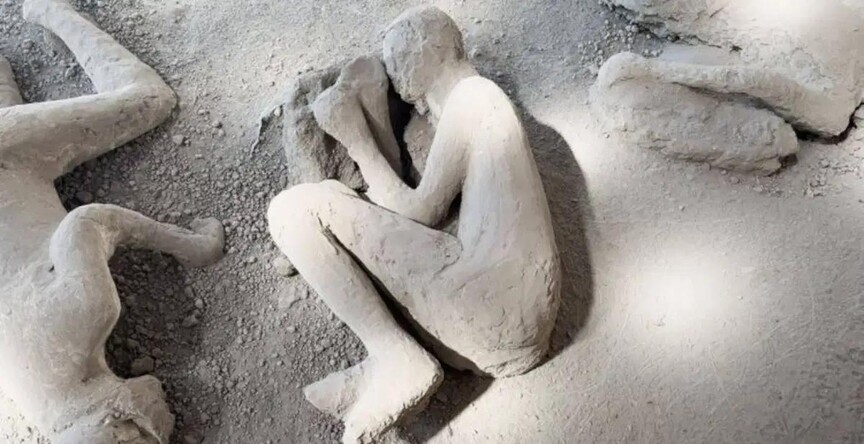
The findings are linked to ongoing research on materials uncovered during excavations led by Italian archaeologist Amedeo Maiuri in 1961 in the Orto dei Fuggiaschi area of Pompeii, where the casts of 14 people were found after being trapped by the pyroclastic flow while attempting to flee the city, according to the Archaeological Park of Pompeii museum on Friday.
The discovery emerged from renewed studies on materials excavated at the site, where the remains of the victims were uncovered after being overwhelmed by a pyroclastic cloud while attempting to escape the city through Porta Nocera.
Researchers examining a small case concealed within one of the casts found a collection of objects believed to belong to a physician, including metal instruments, bronze and silver coins, and a slate plate likely used to prepare medical or cosmetic substances.
Experts said the combination of objects strongly suggests the victim may have been a medicus, or physician, a profession rarely identifiable through direct archaeological evidence.
X-ray analysis, tomography scans, and 3D digital reconstructions carried out by specialists enabled experts to study the contents without damaging the cast. The examinations also revealed details of the container’s mechanical structure, including a toothed-wheel locking system.
Archaeologists, anthropologists, restorers, radiologists, numismatists, and digital modeling experts collaborated to reconstruct details about the victim's life and profession.
“Even 2,000 years ago, there were those who were not doctors, limited to receiving hours, but simply were, at all times, even at the moment of their escape from the eruption, thwarted by the pyroclastic cloud that caught the group of fugitives attempting to leave the city through Porta Nocera,” Pompeii Archaeological Park Director Gabriel Zuchtriegel said.
“This man brought his tools with him to be ready to rebuild his life elsewhere, thanks to his profession, but perhaps also to help others. We dedicate this small but significant discovery to all the women and men who continue to carry out this profession today with a very high sense of responsibility and service to the community,” he added.