
ISTANBUL
By Burcu Arik Ozer/ Nilay Kar
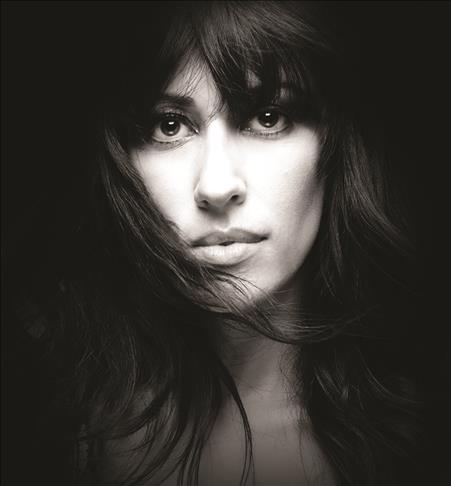
Internationally recognised Portuguese singer Ana Moura is considered to be one of the most popular contemporary fado singers since the day she caught the ear of renowned fado singer Maria da Fé.
Fado, "destiny, fate" is a music genre which can be traced to the 1820s in Portugal, but probably with much earlier origins. An urban folk music, fado is .often compared to American blues for its melancholy themes and stripped-down acoustic instrumentation.
Moura, the youngest fadista to be nominated for a Dutch Edison Award, launched her debut album, “Guarda-me a Vida Na Mão” in 2003. Her sophomore album, “Aconteceu,” came in 2004 and later that year she became the first Portuguese artist to perform at New York's Carnegie Hall.
With her fifth studio album, “Desfado,” the Portuguese singer who is leading the popular resurgence of traditional fado music is on the brink of a crossover.
A series of concerts from around the world and an onstage performance with Mick Jagger cemented Moura's success and Amália Rodrigues Foundation named her the best performer of the year in 2007. This honor secured her title as an acclaimed fado performer in Portugal and her fourth album, “Leva-me aos Fados,” (Take Me to a Fado House) in 2009 quickly reached platinum status.
In an interview with Anadolu Agency (AA) after his concert in Cemal Resit Rey (CRR) in Istanbul, Moura spoke about her music, songs and her new album “Desfado.”
- Fado is a different kind of music for the Turkish audience. Could you tell us a bit about fado’s topics and musical structures?
"Mostly it’s about feelings and emotions. We have two types of fado, the musical fado and the traditional fado. The musical fado is like any other kind of music, but the traditional fado has a special structure. It has a specific lyric and specific melody. The traditional fado has a very special structure.There are many traditional fados. Some fado depends on the number of syllables and the four-line stanza from Portuguese-specific forms of poetry. We can put different poems, even from different poets, in one same structure or melody."
-How would you describe your music? How did you discover fado yourself?
The new album is the blend of many charms. Because I decided to do in the latest years of my career I have been doing collaborations with many different musicians apart from fado. It is a mix of jazz and fado. This album, I wanted to share with audience that I made something different. I just wanted to do something a bit different musically to show people who follow me what I have been doing behind the scenes. I did this album with one of my favourite producers Larry Klein. So the album both has traditional fado, has jazz and traditional folk music. When we collaborate with other musicians suddenly we want to explore new musical environment. There have been collaborations with musicians from distant musical areas, like jazz or rock. I think those collaborations make me feel to discover new music.
-You have worked with Herbie Hancock in your new album. How did that come about?
It was really an amazing experience. Herbie Hancock is one my favourite musicians. I was a big fan of Hancock. This was a coincidence because when we were recording in Los Angeles, Herbie Hancock phoned my manager. Then Larry Klein was talking on the phone with Herbie Hancock because they had another project, telling him, “You know, I’m the studio this moment recording the Portuguese singer Ana Moura.” And Herbie Hancock told him, “Oh, what a coincidence! Because at this moment, I’m listening to her CD at my house.” Larry Klein thought it was such a big coincidence that he said, “Oh come on, you have to come down to the studio.” And that was it! It was a coincidence and I love coincidences. Actually I do not believe in coincidences.
-You have also a "A case of you" cover of Joni Mitchell. Are you interested in bringing fado into a popular music context?
It is a way to introduce but this was you know I had never expected to record in English, but then Larry Klein had challenged me to sing this song. I was a bit surprised but very happy because it's one of my favourite songs ever. I decided to accept. It was not an intention to do that, to sing in English. These musicians discovered my music and wanted to do something new. It made me feel that also, that I wanted to find something new to explore. That’s why I chose Larry Klein as producer, because I have been following him and I really like his work
- It is your first time in Istanbul. How did you find here ? What are the similarities and differences between Istanbul and Lisbon, where you live in ?
"I've not have a chance to discover Istanbul yet but I want to go to the Grand Bazaar and to discover all the colours and smells. It is very nice. On the other had, Istanbul is quite similar to Lisbon. You can feel that you're in Lisbon. Obviously, we don't have beautiful mosques, traditional things that you have. Turkish people should preserve their own culture."
-How do you evaluate Turkish music ? Could you compare Turkish songs with Portuguese one?
"Turkish melodies are similar to Portuguese ones. We have common sounds, which I love.
-You're on the world tour. Which stops do you have after Turkey?
"We're going to northern Europe first and then we will visit Latin America and North America."
englishnews@aa.com.tr
Anadolu Agency website contains only a portion of the news stories offered to subscribers in the AA News Broadcasting System (HAS), and in summarized form. Please contact us for subscription options.