
Istanbulites mark the birthday of an empire
Over five centuries ago a 21-year-old sultan conquered Istanbul and founded an empire. AA spoke to students and teachers at a conference examining the legacy of this world-changing event.
by Ayse Humeyra Atilgan*
ISTANBUL
"One day, Constantinople will be conquered. How wonderful and blessed are the commander of its conquest and his soldiers…"
These words were reportedly spoken by the Prophet Muhammad to encourage commanders and sultans to take Istanbul from the ailing Byzantine Empire almost six centuries ago on May 29, 1453 – a date as important to Turks as Bastille Day to the French or the 1979 Islamic revolution to Iranians.
Tomorrow Istanbulites are preparing to celebrate this pivotal event in a city where dozens of mosques, bridges and streets still bear the name of ‘Fatih’ – the Conqueror.
It has been almost six centuries since Istanbul was conquered under the command of 21-year-old Ottoman Sultan Mehmed II marking the end of Byzantine Empire and turning what was once the heart of the Byzantine realm into the capital of the new Ottoman Empire.
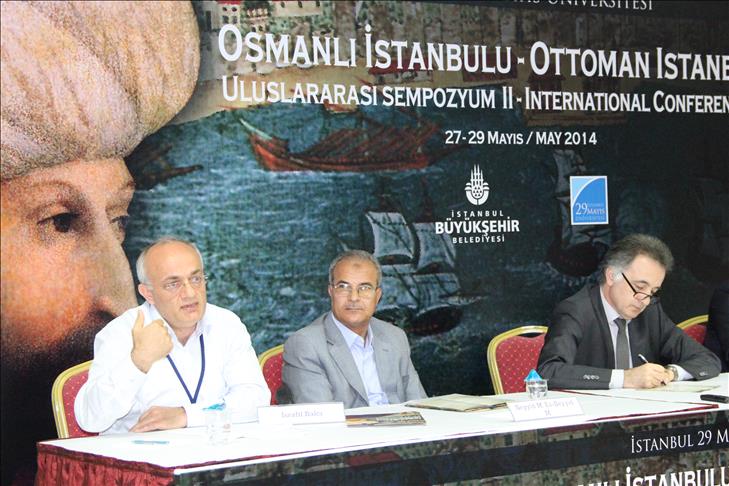
The legacy of this tumultuous event was examined by over 100 academics, students and visitors at the Second International Conference on ‘Istanbul during the Ottoman Period’ this week at the city’s 29 Mayis University – an institution itself named after the conquest.
The taking of Istanbul brought a lot to the world in general, Hussein Alhassan, a 24-year-old student from Ghana, told Anadolu Agency.
"If you look at the history, what the Europeans have done to Africans especially, they took everything we had, even our language," he says.
"But if you look at the conquest of Istanbul, the Ottoman Empire has really done a lot. Wherever they went to conquer, they did not go there for personal interest; they went there to teach the locals, helped people to build themselves by not forcing them to live the way they wanted.
“They did not force anyone to learn the Turkish language. If they were to do that, we could have seen that Turkish would have been the most frequently spoken language in the world," he says.
Professor Ali Akyildiz, on the conference’s scientific committee, said the aim of the gathering was to “introduce Istanbul”, which he said was the heart of Ottoman Empire.
Akyildiz said that the conference included a variety of topics such as ‘The role of the city within World History’, ‘Istanbul as a multi-cultural city and meeting point of civilizations’, ‘Science, learning and literature in Ottoman Istanbul’ and more in 21 different panels.
A student from Azerbaijan, Javadbay Khalizada, 24, said: "The conquest of Istanbul plays a key role in reflecting the power of Ottoman Empire as a Muslim state both in the East and West... People in Azerbaijan regard Istanbul as the greatest city ever, and the Bosphorus as the most magnificent view."
Fellow Azerbaijani student, 23-year-old Khayyam Jalilzada, told AA that his father “like many other Sunni Muslims in his country” are honored by the fact that Istanbul ‘belongs’ to Muslims.
"Mehmed the Conqueror planted the first seeds of Islam in Europe," says academic Seyyid M. Es-Seyyid M. from Alexandria University, Egypt as he gave a speech about the conquest of Istanbul in modern Arab history.
"Istanbul had been established as a Christian city and was accepted as the first Christian capital of a Christian empire, which created an interest in and perception of Istanbul among Islam world," Professor Feridun Emecen, Dean of Literature Faculty at Istanbul 29 Mayis University, told Anadolu Agency.
Pointing to the significance of Istanbul because of its position at the junction of Europe, Africa, and Asia, Emecen said it was not easy for the Christian world to accept that Istanbul was captured by Muslims. "That is why they started an argument that 'Istanbul was invaded by barbarians'," he says.
Professor Emecen said Europeans had a negative view of Ottoman history since 1453 due to 'fears' in their minds resulting from the conquest.
Underlining that Islamization of the Balkans was achieved thanks to Ottomans, Emecen added: "Europe has some fears and we should not forget that it has also been nourished by those fears."
"The conquest of Istanbul was regarded as an invasion in the Balkans which was a part of the Byzantine Empire. However, I accept Ottomans as an empire who achieved the maintenance of Islam in the world," said Adnan Shala, 25, from Albania.
Mesut Guven, 24-year-old student from Kosovo said that before the conquest Turks in the Balkans felt they were detached from Ottomans.
"Today, we are studying at 29 Mayis (May) University, which gets its name from the date of the conquest and we feel at home in Istanbul, which is as beautiful as the best pictures in the world; I feel so lucky to be in such a multi-cultural city," he says.
On Tuesday, Turkish Prime Minister Recep Tayyip Erdogan said his message for the international conference was that Istanbul is among the most important centers not only in Turkish history but in world history.
Traditional celebrations such as music and fireworks by the Bosphorus have been cancelled this year in light of Turkey’s Soma mining disaster.
Nevertheless, the date of 1453 still looms large for Turks and although ‘Istanbul’ may have changed owners, the city today remains proud of a date which now acts as a birthday to an empire.
*Published 28 May 2014
Anadolu Agency website contains only a portion of the news stories offered to subscribers in the AA News Broadcasting System (HAS), and in summarized form. Please contact us for subscription options.