
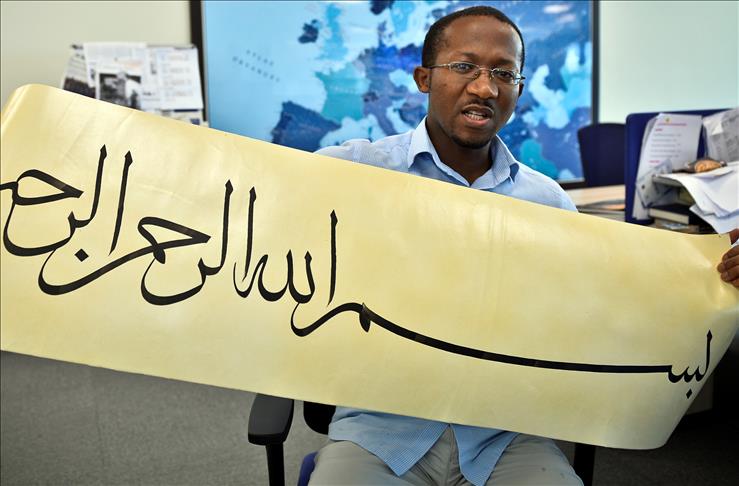
A famous saying goes: the Quran was revealed in Mecca, read in Cairo and written in Istanbul.
The reference is to the book’s delicate Arabic calligraphy.
As Turkey's cultural and artistic capital, Istanbul, revives itself as a center for Islamic arts, it has attracted many visitors from abroad.
One example of a visitor who has excelled at this painstaking and technical art form is Mohamed Hobe, who came from South Africa.
Hobe, 34, who converted to Islam at the age of 11, following his father, now lives in Turkey, and makes his living out of Arabic calligraphy.
Hobe took more than three years to obtain his "icazet" – diploma – from a distinguished master.
Given that this period lasts four to five years on average, Hobe's achievement is significant.
"You need to work really hard," Hobe said in an interview with The Anadolu Agency. "I used to work almost 10 hours a day, non-stop."
These long hours of practice – constant repetition of delicate writing, preceded by ritual purification – feel like meditation or praying, Hobe said. His efforts, he said, have changed him from being hot-tempered into a more patient person.
Hasan Celebi, his 77-year-old award-winning master, has even greater expectations from his students. He tells them that they need to devote “30 hours a day” to the art if they want to succeed in calligraphy, according to Hobe.
But even this daunting regime has not deterred international would-be calligraphists from coming to Istanbul and taking courses, year after year.
Hobe's journey to Istanbul began when he met author, academic and calligrapher Hilal Kazan in 2008. Kazan, a prominent student of Celebi's, was visiting an Islamic institute in Johannesburg when she met Hobe, who was lecturing there at the time.
Following his graduation from high school, Hobe had spent years in Islamic studies, including becoming a ‘hafiz’ – a person who memorizes the whole Quran.
He attracted the interest of Kazan, who now calls him her son. In 2009, he came to Turkey.
He enjoys creativity in his artworks since he got his icazet at the end of 2012, which he describes as the first step in mastering calligraphy.
"It is like graduating from university," he said. "I need to work harder now to get better and more experienced."
Hobe has met hundreds of people coming to his master's lectures on Ottoman calligraphy. Kazan said that Celebi sees a continuous flow of international students.
Some of them have opened workshops in Japan, the U.S., England, Spain, India and China while also enjoying greater attention among Arabic countries from Kuwait to Morocco, spreading this traditional art across the world.
Hobe has volunteered to go back to South Africa to promote calligraphy, the art to which he has dedicated his life.
The Quran was written in Istanbul: The saying still holds true after many centuries, Kazan told AA. And the city continues to draw in this art’s admirers.