- Analysts expect visit will further strengthen both bilateral and multilateral engagement
- Israel will also use Modi’s trip to counter narrative of international isolation, say experts
ISTANBUL
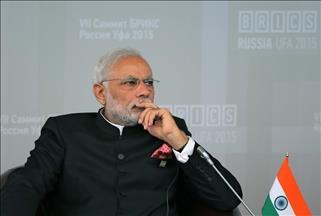
Indian Prime Minister Narendra Modi’s two-day visit to Israel comes at a moment of heightened regional tension and shifting geopolitical alignments, underscoring a partnership that analysts say has evolved from cautious engagement into a multifaceted strategic relationship.
The visit marks Modi’s second trip to Israel, following his landmark 2017 journey, which was the first time an Indian prime minister visited the country. He will meet Prime Minister Benjamin Netanyahu and other senior leaders and deliver an address to the Knesset.
Observers say the visit highlights the steady expansion of India-Israel ties over the past three decades, now spanning defense cooperation, agriculture, water management, and high-tech technology.
“There is a very robust diplomatic, political and economic relationship between the two countries. It is likely that the visit will further strengthen this bilateral engagement,” said Md. Muddassir Quamar, an associate professor at Jawaharlal Nehru University’s School of International Studies.
Defense cooperation is expected to dominate discussions, reflecting Israel’s role as a key supplier of advanced military technology to India.
India accounted for 34% of Israeli defense exports between 2020 and 2024, according to data from the Stockholm International Peace Research Institute (SIPRI).
Indian media reports suggest New Delhi is interested in joint development of ballistic missile defense systems, laser weapons, long-range standoff missiles and drones.
India’s strong interest in anti-ballistic missile technology also works for Israel, which wants to develop as much as it can for new markets on that front, said Ryan Bohl, a senior Middle East and North Africa analyst at the RANE Network.
“A deal with India would allow Israel to scale up the production of things like the Arrow 2 and the Arrow 3,” he said.
Beyond defense, trade ties between the two have grown steadily.
Bilateral trade reached nearly $4 billion in 2024, and the two sides recently signed a bilateral investment agreement. Ahead of Modi’s visit, negotiators also launched the first round of talks toward a free trade agreement.
Experts say a trade deal could boost cooperation in agriculture, water management, waste treatment and desalination technologies. Cooperation in artificial intelligence, quantum technologies and cybersecurity is also expected to feature prominently.
“India has been doing it in the last few years with multiple countries. It has signed agreements with the UAE, Oman and the EU, and it is in talks with the GCC (Gulf Cooperation Council),” Quamar said.
Iran and Palestine
Analysts say Iran is also likely to feature in talks, given India’s longstanding ties with Tehran and its strategic investments, including the Chabahar Port project.
“Iran is an important country. It is part of India’s extended neighborhood and they have had good relations. India used to buy a lot of oil from Iran,” said Quamar.
“India would prefer a peaceful and negotiated diplomatic solution to the Iranian nuclear issue, but certainly India would take into account the Israeli point of view.”
For Palestine, Quamar pointed out that New Delhi has increasingly “de-hyphenated” its engagement with Israel and the Palestinians over the past decade.
“Its conventional position remains the same – it supports the formation of a Palestinian state and a two-state solution. But that does not mean that India’s engagement with Israel will be based on the outcomes of the process.”
He said discussions could include Gaza ceasefire efforts and broader peace initiatives.
“There can be a discussion in the sense of what is the progress in terms of Donald Trump’s peace plan,” he said, noting that India was invited to be part of the US president’s Board of Peace, attending the inaugural meeting as an observer without formally joining.
Alliances and regional diplomacy
India-Israel collaboration in multilateral initiatives such as the I2U2 grouping – comprising India, Israel, the UAE and the US – and the India-Middle East-Europe Economic Corridor (IMEEC) will also be on the agenda, according to Quamar.
In a Cabinet meeting last Sunday, Netanyahu spoke of Israel’s intent to “create an entire system – essentially a kind of hexagon of alliances – around or within the Middle East,” according to The Times of Israel.
He listed India, Greece, the Greek Cypriot Administration and several Arab, African and Asian nations as potential partners.
India’s position, analysts say, remains grounded in strategic autonomy.
“As far as the Middle East is concerned, whether it is Israel, Saudi Arabia, Egypt, Iran or the UAE, when situations of crises and tensions among regional actors, India has refrained from taking sides,” Quamar said.
“It has continued bilateral engagement that is based on Indian interests.”
According to Bohl, Israel would like to draw India into a broader geopolitical alignment.
“India has no interest … so Israel is aiming for a relationship that I don't think India is prepared to offer,” he said.
Optics for Netanyahu
Analysts say the visit also carries political significance for Netanyahu, who is facing both domestic pressure and international diplomatic setbacks.
“It demonstrates that Israel isn’t completely isolated from the great powers, and that’s an important part of Netanyahu’s pitch to the public ahead of the October elections in Israel,” Bohl said.
Former Israeli diplomat Alon Liel emphasized that Israel has “lost a lot of its international standing in the last two-and-a-half years,” including setbacks in relations with Western allies and recognition of Palestine by several countries.
“Since Israel is quite isolated now … this can be presented by Netanyahu as a big diplomatic achievement,” he said.