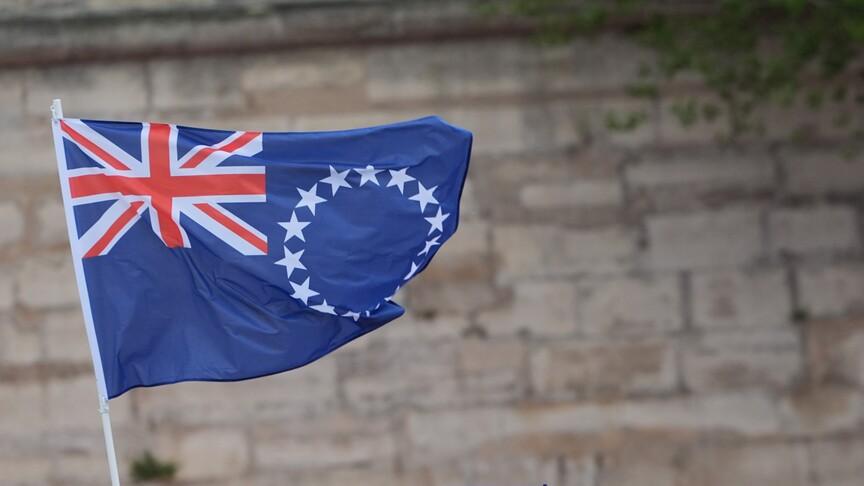
The Cook Islands will hold a general election Wednesday that on paper is about choosing 24 lawmakers for a nation of scattered islands in the South Pacific.
Increasingly, however, the vote is being watched as something larger.
It will be a test of how a small island nation in the South Pacific Ocean navigates intensifying competition between China and its traditional Western partners.
The election comes after an unusually turbulent period in the Cook Islands’ foreign relations, driven by Prime Minister Mark Brown’s effort to broaden the country’s international partnerships, most controversially through a comprehensive strategic partnership with Beijing.
The Cook Islands Parliament says the 18th Parliament was dissolved on June 25 and the election for its successor will be held on Aug. 12.
The country uses 24 single-member constituencies, meaning candidates compete for individual seats rather than through a nationwide proportional system. A party or coalition needs 13 seats for a parliamentary majority.
Brown’s Cook Islands Party enters the election as the dominant force. In 2022, it secured 12 seats compared with five for Tina Browne’s Democratic Party, three for the Cook Islands United Party, one for the One Cook Islands Movement and three for independents.
But this election has become considerably more fragmented.
Asia Pacific Report, citing Cook Islands News, said 63 candidates are running for the 24 seats, with independents accounting for roughly one-fifth of them. One independent, Agnes Armstrong, has already retained the Ivirua Constituency unopposed.
The governing Cook Islands Party is fielding 20 candidates, the Cook Islands United Party 14 and the Democratic Party 12. Smaller groups include the Progressive Party, Independent-Enuamanu and the new Independence Party.
Veteran former politician Norman George told Cook Islands News that political parties appeared to have lost their traditional “attraction, drawcard and magic touch,” arguing that independent candidates were increasingly filling the space.
Cook Islands United Party leader Teariki Heather disputed that assessment, while Democratic Party leader Tina Browne has ruled out pre-election coalition agreements.
The Cook Islands Party, meanwhile, has previously relied on independent support to form governments and is seeking a fifth consecutive term, according to Asia Pacific Report.
The Cook Islands is self-governing but exists in free association with New Zealand, an arrangement dating to 1965. Cook Islanders are New Zealand citizens, and Wellington retains important responsibilities in areas including defense and foreign affairs when requested.
That relationship was strained in 2025, when Brown’s government signed a five-year Action Plan for a Comprehensive Strategic Partnership with China.
The agreement covers areas including deep-sea minerals, hydrography, disaster management and cultural cooperation. New Zealand complained that it had not been adequately consulted before the agreement was signed, while opposition groups in the Cook Islands questioned its transparency.
RNZ reported at the time that New Zealand Prime Minister Christopher Luxon stressed the expectation that the two governments would consult transparently on matters touching defense and security. Brown rejected suggestions that his government was acting secretly and said its international agreements would serve Cook Islands interests.
Hundreds of people subsequently protested in Rarotonga amid concerns about the China agreement and a separate, later-abandoned proposal for a Cook Islands passport. The government maintained that closer relations with Beijing were intended to complement rather than replace its established relationships with New Zealand, Australia and other partners.
The Royal United Services Institute (RUSI), the world's oldest and the UK's leading defense and security think tank, described the China-Cook Islands partnership as part of a broader transformation of Pacific geopolitics.
The Cook Islands has a land area that is tiny by global standards but an exclusive economic zone covering nearly 2 million square kilometers. RUSI said that maritime territory and its resources have increased the islands’ strategic importance as competition between China and Western powers intensifies.
The Chinese state-run Global Times has presented the election and surrounding debate from Beijing’s perspective, against criticism that Western powers are increasingly treating Pacific island countries as arenas for geopolitical competition rather than independent states pursuing their own diplomatic and economic interests.
That competing interpretation goes to the heart of the election’s international significance: whether closer Chinese engagement represents an erosion of the traditional regional order or simply the Cook Islands exercising greater diplomatic autonomy.
The competition is not only about diplomacy.
Some of the world’s potentially important deposits of polymetallic nodules lie on the Cook Islands seabed.
The Cook Islands Seabed Minerals Authority estimates that the country's continental shelf contains about 6.7 billion metric tons of nodules potentially holding roughly 20 million metric tons of cobalt alongside manganese, nickel, copper and other materials important for batteries, advanced manufacturing and defense technologies. Commercial extraction has not been approved.
That has drawn Washington more deeply into the picture.
In February, the Cook Islands and the US established a non-binding framework for cooperation on critical minerals and rare earths, including deep-sea minerals. The agreement covers research, exploration, investment, processing and supply-chain development while explicitly preserving Cook Islands sovereignty over decisions concerning its seabed.
US Ambassador Jared Novelly said in July that Cook Islands seabed minerals had become a top American priority as Washington seeks alternative supplies of critical minerals and tries to reduce dependence on supply chains dominated by China.
American scientific involvement is expanding as well. The US National Oceanic and Atmospheric Administration announced in May that it would work with the Cook Islands Seabed Minerals Authority to map and explore deep waters around the country, including abyssal plains and the Manihiki Plateau.
The result is an election taking place at the intersection of unusually large forces for such a small electorate.
Cook Islanders will vote principally on domestic questions—government performance, public services, representation and the appeal of individual candidates. But the government they produce will also inherit decisions about how closely to engage China, how to manage the country's unique relationship with New Zealand and how far to pursue emerging cooperation with the United States.
And beneath those choices lies another question that could shape the Cook Islands for decades: who, if anyone, will eventually develop the mineral wealth sitting thousands of meters below its surrounding ocean.
For Beijing, Washington and Wellington, Wednesday’s election therefore carries significance far beyond the 24 seats being contested.
For Cook Islanders, the challenge may be precisely the opposite, ensuring that an election about their country does not become merely another contest between much larger powers.
news_share_descriptionsubscription_contact

contact_the_ombudsman
is_there_an_error_in_this_story