Burc Eruygur
14 April 2026•Update: 14 April 2026
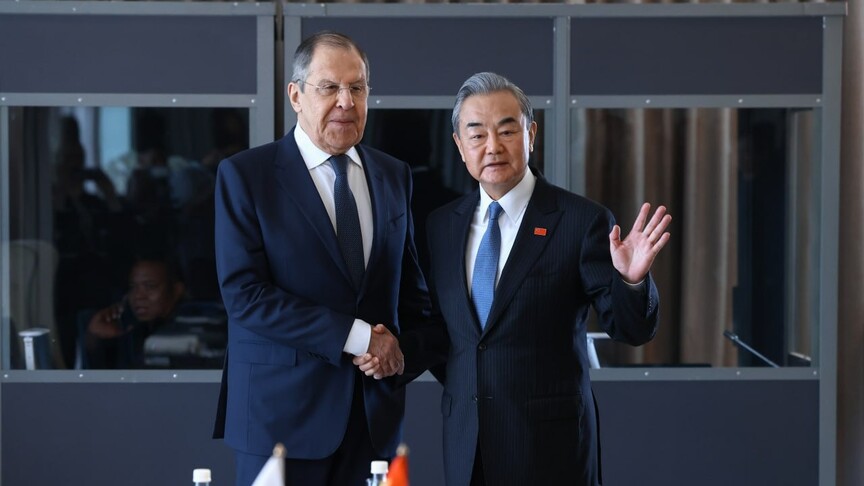
Chinese Foreign Minister Wang Yi and his visiting Russian counterpart Sergey Lavrov on Tuesday discussed the US-Israeli war with Iran ahead of a potential second round of talks between Washington and Tehran in Pakistan, state media reported.
The two sides also discussed the Ukraine crisis and Asia-Pacific affairs, Beijing-based Xinhua News reported.
"The current international situation is undergoing severe turbulence; unilateral hegemonism is becoming increasingly harmful; the global governance system is facing profound adjustments," Wang said, adding that the cause of peace and development for humanity is confronting "serious" challenges.
Lavrov, for his part, said that “dangerous games” are ongoing over Taiwan and the South China Sea.
He said he agreed with Wang’s assessment that the “foundations of international relations are being severely tested today,” referring to developments earlier this year in Venezuela, as well as ongoing events in the Middle East and the situation surrounding Ukraine.
He claimed that the Russia-Ukraine war is being exploited, primarily by European countries, to “hatch plans to create a new aggressive bloc in the west of the Eurasian continent” involving Kyiv, with the intention of then using this bloc to target Russia.
“In the eastern part of the Eurasian continent, dangerous games are also continuing: both in the Taiwan issue and in the South China Sea issue, and the situation on the Korean Peninsula is escalating,” Lavrov further said.
He went on to accuse the West of attempting to “disintegrate” what he described as the "ASEAN-centric space" by creating “small-geometry, bloc-like structures” designed to contain both Moscow and Beijing.
“Our entire vast continent requires constant attention,” Lavrov added, expressing confidence that he and Wang will be able to discuss their practical steps in line with the initiatives put forward by their presidents in detail.
Lavrov arrived in Beijing on a two-day official visit for talks expected to discuss a broad range of issues related to bilateral cooperation, prospects for contacts at various levels, and coordination on the international stage, with a focus on joint work in multilateral platforms, according to the Russian Foreign Ministry.
The ministry said that a "detailed exchange of views is expected on a number of hot topics and regional issues, including the Ukrainian crisis and the situation in the Middle East."
Washington and Tehran failed to reach an agreement in Pakistan's capital over the weekend during talks that were part of broader efforts to end the US-Israeli offensive on Iran that has killed more than 3,300 people since Feb. 28, before a fragile two-week ceasefire was brokered last week.
US President Donald Trump later announced a naval blockade of the Strait of Hormuz, which took effect at 1400GMT on Monday.
Notably, Russia and China last week vetoed a UN Security Council resolution calling for coordinated "defensive" measures to ensure freedom of navigation in the Strait of Hormuz.
Following their talks in Beijing, Lavrov and Wang signed a plan for inter-ministerial consultations for 2026.