By Max Constant
BANGKOK
Thailand has played a central role in the boat crisis presently sweeping Southeast Asian shores, but while neighbors have offered to temporarily host around 7,000 migrants stuck at sea, Bangkok is yet to open its doors.
On Wednesday, Malaysia and Indonesia's respective foreign ministers, Anifah Aman and Retno Marsudi, told media after three-way talks on the crisis with their Thai counterpart that they had agreed to offer temporary shelter to "irregular migrants" providing others then step in.
But while Thai Foreign Minister General Tanasak Patimapragor joined them in strongly condemning the people smuggling and human trafficking operations at the heart of the operation, the kingdom offered no haven of its own.
Thai junta chief-cum-Prime Minister General Prayuth Chan-ocha sought to explain Thursday.
“Thailand is a transit country, so we have more problems than other countries. In terms of policy, we agree to help but all remains to be discussed,” he told the Bangkok Post.
It was transiting, however, that got Southeast Asia into this mess - lax and corrupt policing by Thailand allowing smuggling camps on its border with Malaysia to flourish, many of which were being used to hold Rohingya and Bangladeshis against their will while kidnappers collected ransoms from their families back home.
For decades, Thailand has hosted an array of migrants.
After the coming to power of the Khmer Rouge in April 1975, up to 300,000 Cambodians and a number of Vietnamese fled the genocide and lived in camps on the Thai-Cambodian border, until they were closed in 1993 when the remainder of the refugees who had not been resettled in the west returned home.
In 1998, following a massacre in Myanmar, tens of thousands of Burmese and ethnic minority members fled the conflict into Thailand. Around 150,000 of them are still living in a string of camps along the Thai-Myanmar border, despite elections in 2010 that brought a quasi-civilian government to power.
More recently, the Thai south has become a way station for Muslim Rohingya fleeing political persecution and misery in Myanmar's west. Human smugglers kept these migrants in camps hidden in the jungle, in order to extort money from their families before letting them go to Malaysia, their intended destination.
This history, combined with the junta prioritizing the elimination of illegal immigration, has left the notion of the hosting camps employed by Indonesia and Cambodia extremely unlikely, even if they are provisional.
In a statement released Wednesday, Amnesty International acknowledged the refusal of Thailand to open shelters, saying that the country “did not sign on to the commitment to provide temporary shelter, citing domestic legal constraints.”
On May 1 - spurred by the international outcry over the discovery of 33 bodies at a people trafficking camp - Thailand launched a crackdown, smugglers fleeing and boatloads of the migrants then turning up on Thai, Indonesian and Malaysian shores, while many more remained at sea.
So far, the junta has obtained 71 arrest warrants for human trafficking suspects from the courts.
Among the 33 detained under human trafficking charges are police officers, local officials and a former president of Satun provincial administration organization, Pajjuban Angchotiphan, considered "a human-trafficking kingpin."
The European Parliament adopted a resolution Thursday calling on Thailand to hold an immediate criminal investigation into the mass graves and to ensure that those responsible are brought to justice.
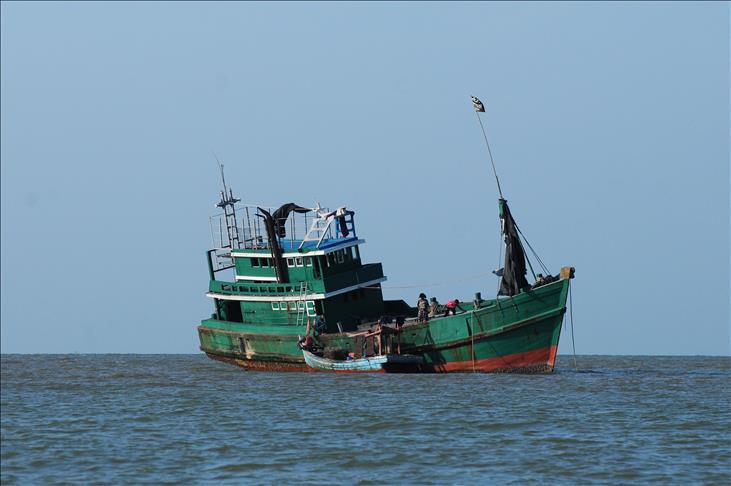
Some of the estimated 7,000 Rohingya Muslims and Bangladeshis on the boats have been taken in, emaciated passengers whisked to hospitals and holding centers, but of late the navies of the three countries have been turning the vessels back to sea after providing them with food and water.
Thai Army Chief Udomdej Sitabutr defended Thailand’s position from criticism Wednesday, choosing instead to turn the attention on Myanmar.
“Thailand is making its best efforts to handle the Rohingya situation as a country on the transit route and the critics should lend a hand,” he said.
"A large part of the migrants are Rohingya fleeing persecution in Arakan State in western Myanmar, where they are refused Burmese [Myanmar] citizenship."
Sitabutr reiterated that the Thai navy had provided food and water supplies to the migrants’ boats it found off its coasts, and that these migrants did not want to come to Thailand but to continue their journey to Malaysia.
He added that those who do not want to go a third country will be detained, but instead of being placed in camps where they will await eventual relocation to a third country, they would be treated as illegal migrants.
"This is not a human rights violation,” he underlined.
He called on “those who are working to protect the human rights of the Rohingya migrants… to take them - if their countries are ready.”
* Anadolu Agency correspondent Hajer M'tri contributed to this report