BANGKOK
Members of opposing political factions gathered Sunday at a series of Thai junta-organized events - their purpose, to “bring back harmony and happiness” to the country.
In an environment that would have made North Korea's supreme leader Kim Jong Un proud, a military band struck up in Pathum Thani, a "Red Shirt" stronghold north of Bangkok. As uniformed soldiers danced with some participants to historic military music, others distributed curries and Thailand's famous cuisine.
Elsewhere, military barbers gave out free haircuts.
“When everyone has a common understanding, reconciliation can begin,” an unnamed officer organizing the event told The Nation newspaper.
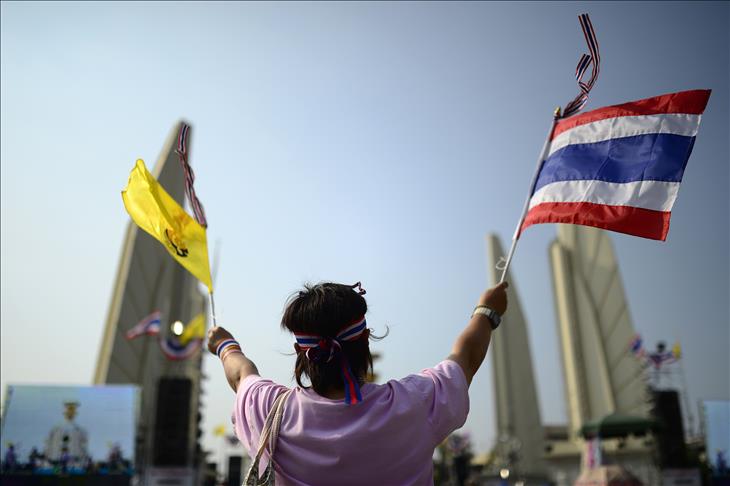
"Red Shirts" - supporters of the Shinawatra political clan, of which Yingluck Shinawatra was the latest ousted PM - did not participate in the jovialities, instead suspiciously observing from a distance. The relaxed few - drinking, eating, gently hobnobbing with the military - were "Yellow Shirts" - Royalists defending the traditional establishment, who have welcomed the military intervention.
The event was one of the first outlined in Friday's speech by General Prayuth Chan-ocha, the leader of the new junta that seized power on May 22.
The coup maker - who now also holds the post of prime minster - explained that “fully democratic elections” will be held at the end of a campaign of reconciliation, during which a Reform Council and National legislative assembly will change the political system to bring order to the country.
A new government will be "set up" by October, he said, elections not taking place until "the end of 2015."
On Sunday, other events - including "a luncheon" in the northern province of Chiang Mai - saw Red and Yellow shirt leaders invited “to dilute their colors, leaving only those of the national flag”
The events were organized by the Internal Security Operational Command (ISOC), the military agency in charge of reconciliation efforts.
The ISOC, which played a major role in brutally exterminating a brief leftish insurgency which took place in the country in the 1970s, will set up reconciliation centers in all provinces “to bring back happiness to Thai people,” reported Khao Sod online, a local information website.
“Reconciliation will begin from the family level to the national levels, as the conflict has sunk so deep to the extent that the subject of politics cannot even be raised at the family table during dinners,” the website added.
The military has also organized sessions for political detainees in military camps, where they are told to love “Nation and King” and made to sing patriotic songs.
One journalist detainee - Pravit Rojanaphruk, who was held for seven days and released Saturday - described "Being inside the army base as like being in a Big Brother reality show.”
The Thai military seized power May 22 after seven months of anti-government protests by the Bangkok middle-class against an administration led by Yingluck Shinawatra, which was mostly supported by rural people in Thailand's East and north.
Anti-government protesters then successfully blocked February 2 elections, which were later cancelled by the Constitutional Court.
Yingluck was removed from her post by a Constitutional court decision on May 7 for abuse of power, but was replaced by one of her ministers, Niwatthamrong Boonsongpaisan, who remained at the helm of the government until the coup.
www.aa.com.tr/en