PRETORIA
South Africa's main opposition party, the Democratic Alliance (DA), said election results in the country's recently concluded parliamentary polls showed that the public was abandoning the practice of voting according to race.
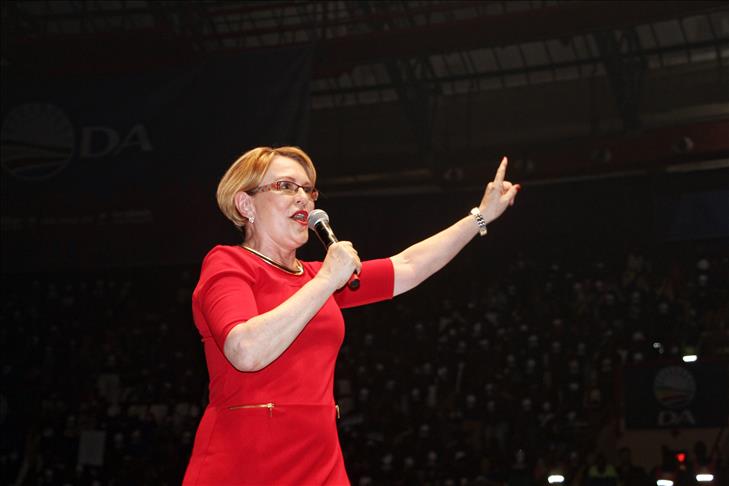
"This is encouraging for the future of our democracy," DA leader Helen Zille said in a Friday statement.
In the past, many South Africans had viewed the DA as being the party of privileged whites and a few educated blacks. But this appears to have changed with the party gaining support from diverse racial groups.
"We raised our support among black South Africans from 0.8 percent in 2009 to approximately 6 percent in 2014, with 40 percent of these votes won in Gauteng," Zille added.
She said that roughly 760,000 black South Africans had voted for the DA this time around.
"We raised our support significantly among Indian South Africans [from 53.7 percent to 61 percent] and colored South Africans [from 55.5 percent to 67.7 percent]," the opposition party leader revealed.
"Our support among white South Africans increased from 83.9 percent to 92.8 percent," she added.
On Wednesday, South Africans voted for parliamentary and provincial representatives in the country's fifth democratic election since the end of apartheid in 1994, when the nation's blacks were granted the right to vote.
More than 25 million South Africans were eligible to vote in the polls, which came nearly five months after the death of Nelson Mandela, the country's first black president.
The ruling African National congress (ANC), however, remains in the lead with 11,332,696 votes, or 62.23 percent of the total, followed by the DA, which picked up 4,034,263 votes, or 22.15 percent.
-Gratitude, defiance-
The DA thanked voters who voted for the party for their support and pledged to work hard over the next five years to vindicate supporters' faith in the party.
"The DA would like to thank every South African who voted for us on Wednesday. We deeply appreciate the support they have given us," Zille said.
In 2009 general elections, the DA won 2.9 million votes. But in 2014 elections, it garnered over 4 million, representing some 22.15 percent of the total.
"The DA's increase from 16.6 percent in 2009 to 22.2 percent in 2014 [a 33.7-percent increase] shows that we are growing across South Africa," Zille asserted.
Zille went on to say voters had responded positively to their campaign, which had promised honest government and employment creation – a sign, she said, of public frustration with the ruling party's performance.
"We registered significant national growth while the ANC's support decreased from 65.9 percent in 2009 to 62.2 percent in 2014," Zille added.
In provincial elections, the DA – which governs the Western Cape – retained the province with an increased majority, from 51.5 percent to 59 percent.
"This significant increase is a vote of confidence in the DA's track record in government," Zille said, adding that her party would also become the official opposition in five new provinces: KwaZulu-Natal, the Eastern Cape, the Free State, the Northern Cape and Mpumalanga.
Zille contended that the DA was the only party to have made consistent gains in every election since 1994, when it won just 1.7 percent of the vote.
"Other parties have come and gone, but we keep winning and growing. We are stronger and bigger than ever," she said.
The DA leader pledged to serve all South Africans and continue to hold the government accountable for incompetence.
"This is a very exciting time for the DA and South Africa. We are on track to achieve our historic mission of realigning politics and unseating the ANC from national government in the next decade," Zille said.
By Hassan Isilow
englishnews@aa.com.tr