- ‘What you simulate in one day, one hour with traditional systems, you can get an answer (for) in one minute,’ Laurence Rouil notes
Artificial intelligence is revolutionizing atmospheric monitoring, making forecasting and early warning systems faster, according to the director of the Copernicus Atmosphere Monitoring Service (CAMS).
Laurence Rouil described AI as a "game changer" in atmospheric forecasting, saying the technology can reduce processing times from hours to minutes while maintaining encouraging levels of accuracy.
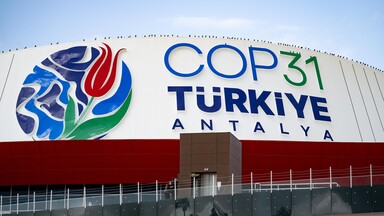
“Yes, artificial intelligence is a game changer, definitely," Rouil told Anadolu on the sidelines of the COP31 climate summit in Antalya.
She said CAMS began implementing AI-based and hybrid systems over the past two years to complement forecasting and atmospheric analysis models developed over the previous decade using physics and mathematical equations.
"What you simulate in one day, one hour with traditional systems, you can get an answer (for) in one minute, two minutes with an AI system, which is really important for developing some early warning systems," Rouil noted.
Rouil said the service currently operates two systems in parallel, one based on established physics-based models and another experimental system using AI approaches, allowing researchers to compare their forecasts against each other and with actual observations.
“We compare our forecast and the AI systems are quite good. This is very encouraging,” she underscored.
However, Rouil stressed that AI was not yet ready to replace traditional modelling methods, as reliable training data remains essential for developing accurate systems.
"We need to have good AI based systems, we need to train those systems," she said, adding that observations and data generated by established physics-based models could both contribute to this process.
“What we produce with the physics based models that (have) run for decades, that we trust, we know they are good. And they provide amazing amounts of data that could be used to train our system,” Rouil noted.
She pointed to the ERA5 climate reanalysis dataset, developed by the European Centre for Medium-Range Weather Forecasts (ECMWF), as a vital benchmak for training AI-based climate monitoring systems.
“The data to train the AI system should be trustworthy, and this ERA5 reanalysis is really a reference," she added.
Traditional and AI-driven methods will therefore continue to complement each other in atmospheric monitoring, she said.
Mediterranean faces growing ozone and wildfire threats
Turning to Europe's environmental challenges, Rouil warned that rising temperatures are worsening ozone pollution, particularly across the Mediterranean, where intense heat and sunlight accelerate ozone formation.
She said air pollution indicators, including particulate matter and nitrogen oxides and dioxides, had shown encouraging downward trends due to regulatory measures, but ozone remained a major concern.
"Tropospheric ozone -- ozone that we breathe -- is an air pollutant with harmful effects on (the) respiratory system, and is also at the same time a greenhouse gas," she said.
Rouil explained that ozone formation is triggered by chemical reactions involving heat and sunlight, making Mediterranean countries particularly vulnerable to high concentrations as temperatures rise.
"For me this is one of the main issues with wildfires, which are also enhanced and worsened by climate change conditions," she said.
She cited the summer of 2026 as a stark example of the increasingly challenging conditions facing Europe, citing repeated heat waves, high temperatures, elevated ozone concentrations and wildfires across the continent.
Rouil described this year’s summer as “really strange” with heat waves starting very early and lasting through September alongside wildfires that even hit northern countries.
“This is really new and it might happen more often in the future," she said.
Earth observation can help assess emission reductions
Rouil also highlighted the significance of using satellite observations and other Earth observation data to improve the monitoring of greenhouse gas emissions and evaluate whether countries are meeting their climate pledges.
She said Copernicus is developing an "observation-based emission" approach that cross-checks emissions detected via satellite against the figures countries self-report.
“This is useful for the countries because it can help them get more data for their reports and assess the efficiency of the mitigation strategies that they put in place," Rouil stressed.
She added that the approach could also support the European Commission and the EU in assessing progress toward commitments under the Paris Agreement.
Rouil acknowledged that monitoring emissions remained challenging because they originate from numerous sources, particularly human activities linked to industry, transport, urban development and everyday lifestyles.
She nevertheless stressed the need for countries to begin taking action, including through measures targeting specific sectors and greenhouse gases.
“This is high time to do something,” Rouil further underscored.
Methane action could deliver earlier results
Rouil said methane warrants particular attention because it is a potent greenhouse gas, meaning reducing its emissions could produce results faster than efforts targeting carbon dioxide.
"Methane is a powerful greenhouse gas emissions and action on methane could be seen in an earlier time than actions on CO2," she explained.
She welcomed discussions at COP31 on methane and waste management and said: “This is something that Türkiye wanted to work on and I think that this is very welcome because this is an important part of emissions.”
Rouil further identified the energy and agriculture sectors as important areas for greenhouse gas mitigation, while also pointing to international shipping as another sector where further regulatory efforts were needed.
“I think that this COP is really important regarding the need to act on the greenhouse gases,” she further said.