Mertkan Oruc and Emir Yildirim
30 September 2026•Update: 30 September 2026
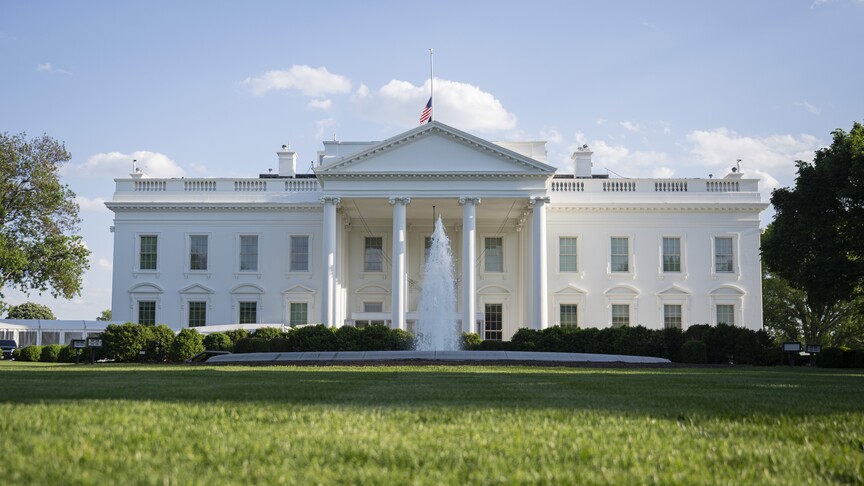
Artificial intelligence (AI) has been positioned as a central element of the global power struggle, with the White House under US President Donald Trump gathering AI leaders and reigniting debates over techno-feudalism, the head of the Turkish AI policy association AIPA told Anadolu.
Zafer Kucuksabanoglu stated that the world’s most powerful tech figures took part in the meeting, which he said showed a snapshot of how the new world order is taking shape, with figures like Elon Musk, Jensen Huang, Mark Zuckerberg, Sundar Pichai, Satya Nadella and Jeff Bezos seated alongside senior government officials.
He noted that these tech billionaires were also prominently placed during Trump’s January 2025 inauguration, which served as a harbinger of this new era.
“This concentration of power is precisely at the heart of the ongoing techno-feudalism debate — for instance, Trump’s push to redefine AI as ‘superintelligence’ is not just a terminological shift but a claim to global leadership in this advanced technology as a political and strategic narrative,” he said. “Trump asserted that the AI competition is essentially between the US and China, while stressing that development must not slow down.”
Kucuksabanoglu stated that industry leaders recently called for slowing the pace of AI development for safety reasons, but Washington is arguing that slowing down will only benefit China.
“The US approach can be summarized as controlling the technology but not slowing down and enhancing security but not losing the pace of innovation — I think the central AI debate will be shaped by these balances in the coming period,” he said.
He emphasized that Türkiye must be a part of this global transformation, urging local decision-makers to prioritize AI and assess what these global developments could mean for the country.
“The assessment of potentials must take place not only within tech circles but on a platform gathering the public and private sectors, universities and civil society,” he said. “Decision-makers and developers must sit down much more frequently and listen to one another as this is a field where significant changes come to the fore within a matter of months, so annual meetings are no longer sufficient.”
Kucuksabanoglu stated that AIPA launched monthly dialogue meetings to bridge the gap between the Turkish public sector’s policy perspective and the private sector’s hands-on experience.
“It’s not realistic for Türkiye to compete with the US and China on the same scale when it comes to every area of AI, so Türkiye should identify a few strategic areas and allocate resources there — we’ve built a strong industrial base and a culture of production through our defense sector, while other sectors like finance, healthcare, logistics, tourism and public services are areas where AI could generate significant added value,” he said. “I would add agriculture to these areas as AI can help in a range of activities, from improving efficiency and water use to early disease detection and crop planning.”
“We see the US innovation- and competition-related approach, while Europe has its own more regulatory approach, and China has a whole other model, but Türkiye does not have to copy any of these approaches — we must establish our own balance, one that ensures security without stifling innovation and accelerates AI transformation. Türkiye may not become an AI leader in every field, but it must determine where it will stand in this new world order, as what we’re discussing today deals with the future of the economy, production, agriculture, companies, the workforce and global power balances,” he added.