- Iran’s underground facility gains new importance with Israeli intelligence reports placing it as Tehran’s nuclear fallback facility
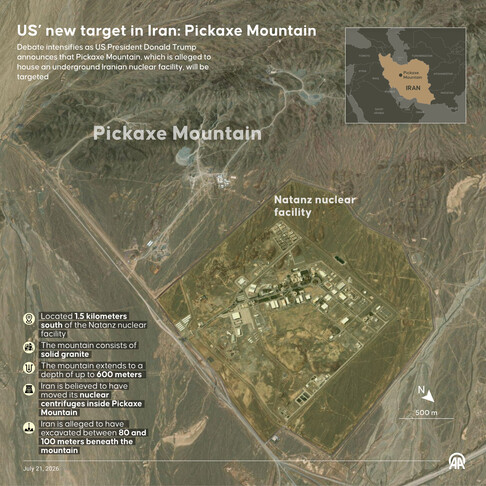
As US President Donald Trump escalates his warnings against Iran, attention has turned to Pickaxe Mountain, an underground facility near the Natanz nuclear complex in the central province of Isfahan.
During a meeting with Lebanese President Joseph Aoun at the Oval Office on Tuesday, Trump reiterated his threats to target the site, saying, “If I thought they could do something about it, I would never say that, but we’ll be hitting that area pretty soon, and very heavily.”
Asked whether Iran had moved nuclear centrifuges to Pickaxe Mountain, Trump said: "Well, I think that they may have. We don't have it on record."
Meanwhile, new Israeli reports suggest that Iran moved thousands of uranium-enrichment centrifuges into tunnels deep inside Pickaxe Mountain last fall.
US and Israeli officials noted that the transfer of sensitive equipment inside the mountain increases concerns that Tehran is working to ensure continued uranium enrichment, even in the event of a large-scale military attack on its soil, according to Israeli media.
During the intense bombing campaign earlier in the year and operation "Midnight Hammer" last year, American and Israeli strikes pummeled three of Iran’s main nuclear sites - Isfahan, Fordow and Natanz.
Explosions were reported on Monday across southern and southeastern Iran, while air defenses were activated near the Bushehr Nuclear Power Plant, according to Iranian media, which indicate that a strike on Pickaxe Mountain is imminent.
In an interview on the Hugh Hewitt show last week, Trump said: “We have eyes on it and Pickaxe Mountain is a possible target for a nice big fat shot right in the front door…We’re watching Pickaxe Mountain very closely. We don’t see any activity there.” Trump finished the interview with a more definitive statement: “We're going to take out Pickaxe Mountain. Tell the Iranians to be ready.”
Where is Pickaxe Mountain?
The site sits roughly 1.5 kilometers south of the Natanz enrichment complex in Isfahan province, in Iran's Zagros mountain range.
Its official name is the Shahid Alimohammadi facility, though it is universally known by the nickname Pickaxe Mountain, translated from the Persian Kuh-e Kolang Gaz La.
The compound covers roughly one square kilometer of mountainside, and Iran has built a security fence several kilometers long around the mountain, tying into the perimeter fence around the Natanz complex, with two paved access roads climbing toward the tunnel entrances.
Why was it built?
The start of the construction can be traced back to a July 2, 2020 sabotage operation, widely attributed to Israel, that destroyed an advanced centrifuge production plant at Natanz.
Shortly after, Ali Akbar Salehi, then head of Iran's Atomic Energy Organization, told parliament's National Security Committee that Iran would build a new centrifuge assembly hall "in the heart of the mountain," and that work had already begun.
Iran's official position, maintained ever since, is that Pickaxe Mountain is purely a manufacturing site, replacing the destroyed above-ground facility, which had been built to assemble thousands of advanced centrifuges annually.
How big is the complex at Pickaxe Mountain?
A January 2022 assessment by the Institute for Science and International Security (ISIS) put the underground halls between 78 and 145 meters below the mountain's summit, and more recent satellite analysis reportedly shows the complex carved to more than 100 meters below bedrock, deeper and more fortified than Fordow, to a depth considered very difficult to reach even with the most advanced US bunker-penetrating bombs.
The mountain itself rises 1,608 meters above sea level, and is notably taller than the ridge above Fordow.
Defenses include hardened, extended tunnel portals layered with concrete and earth, and a double fence-and-wall perimeter with a patrol route that Iran began building in 2025.
Why is Pickaxe Mountain important now?
Pickaxe Mountain has risen to importance not because there is an ongoing, verifiable enrichment mechanism, but because it is purpose-built to be harder to destroy than any other facility.
If true, that would give Tehran a meaningful path to reconstitute enrichment capacity even after the damage done to its declared sites in 2025 and 2026 and a secure site to preserve Iran’s surviving centrifuge stock.
First reported by the Wall Street Journal, satellite imagery cited by ISIS shows continued vehicle activity and construction at Pickaxe Mountain even while Iran's bombed Natanz and Isfahan sites remain largely dormant.
ISIS fellow Spencer Faragasso has called the site's ongoing construction a hedge by Iran in case negotiations fail, assessing it's likely large enough to house an actual enrichment plant, not just assembly lines.
Iran disputes the enrichment-plant theory outright.
Foreign Minister Abbas Araghchi has said Iran has no undeclared enrichment sites and that all its facilities are monitored by the International Atomic Energy Agency (IAEA).
However, the IAEA has not been granted access to the facility. The agency's Director-General Rafael Grossi has said Iran has not provided verifiable answers regarding the site's activities or clarified whether nuclear material could be present there.
Iranian officials have restricted IAEA access to several nuclear sites since the conflict.
Trump has repeatedly named the site as a target for future strikes if it isn't opened to inspectors, saying on July 13: "We see no activity there. They're not doing well with their nuclear situation. Every time we hear about it, we blow it up. So they don't like talking about it. But we'll probably give Pickaxe a shot relatively soon.”