ISTANBUL
Slogans, symbols and logos have been used to inspire a generation, unite a society and change a nation. From the political extremes to mainstream election campaigns, would-be leaders have used unforgettable symbolism as a way of connecting with potential supporters.
Despite controlling Germany for only 10 years the Nazi party’s swastika would become an unforgettable image, burned onto the memories of millions of people – as would the hammer-and-sickle symbol of communism.
Even in mainstream politics Barack Obama’s ‘Yes We Can’ slogan and ‘Hope’ poster – inspired by the United Farm Workers’ Movement – helped elect the first African-American President of the U.S. Many political parties and candidates in Europe and the U.S. have spent a fortune on advertising agencies and 'creatives' to devise attention-grabbing logos and symbols.
As all three candidates to become Turkey’s first directly elected president finally launched their campaigns, the effect of election material on the voters and the candidates’ message has come in for scrutiny.
Ekmeleddin Ihsanoglu – a joint opposition party candidate – has faced some tough reactions to his campaign slogan which plays on the Turkish word ‘ekmek’ meaning both the noun ‘bread’ and the verb ‘to plant’.
Some have criticized the slogan ‘Ekmeleddin for Bread’ accompanied by a logo showing a wheat field in the shape of Turkey, accusing it of being weak and ill-thought out.
On the other hand, the slogan has been praised by others as bread is an important symbol in Turkish culture symbolizing fairness, equality and making a living.
Turks will go to polls on August 10 to choose their first popularly elected president. The president has been previously chosen by parliament.
The editor-in-chief of Marketing Turkey, Gunseli Ozen Ocakoglu, says Turkish people have a strong visual memory, adding that Ihsanoglu’s logo and slogan is “pretty strong”, appealing to a solid base in terms of meeting voters’ needs.
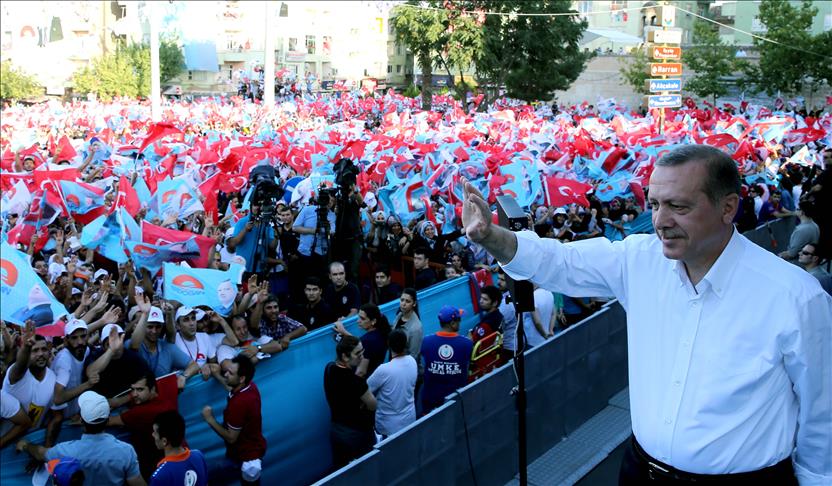
Fellow candidate – and current Turkish prime minister – Recep Tayyip Erdogan has chosen a semi-circle representing the rising sun with a winding road leading to it. The logo is thought to bear a subtle tribute to the Prophet Mohammad.
“Did you know that ‘Mohammad’ in Arabic is used in the logo of our presidential candidate, Erdogan?” Finance Minister Mehmet Simsek wrote this week on Twitter.
Erdogan’s logo has been the subject of debate since it bears a striking resemblance to the one used in President Obama’s campaign in 2008 and 2012.
Assessing Erdogan’s presidential slogan and logo, Ocakoglu said his election campaign gives a confident message that he is the only leader, thinking his name alone would be sufficient.
However, Ali Saydam, Professor of Communications at Bahcesehir University in Istanbul, argues that the logos and slogans used in presidential campaigns have little effect over voters’ choice, claiming instead that bombardment of visuals divides perceptions in a negative way.
“If the voter has a positive impression about the candidate, anything about the candidate is affirmed by the voter. Few voters pay attention to the visuals, organization, public relations and advertisement,” Saydam claims.
Describing Kurdish, problem-focused Democratic People’s Party candidate Selahattin Demirtas decision to use his picture instead of a logo as bold move, Ocakoglu says the contest's youngest candidate seems to give the message that “there is only myself and what I promise”.
However, it may be that all the visual campaigning in the world may make little difference on August 10. If no candidate can secure more than 50 percent of the votes in the first round, a runoff will be held on August 24 between the top two candidates.
www.aa.com.tr/en