ANKARA
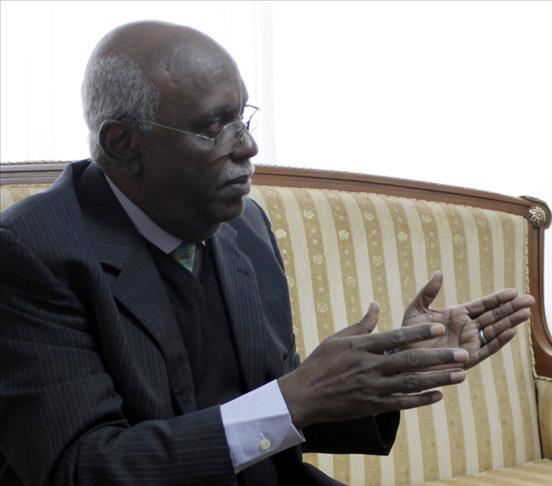
Undersecretary of Sudanese Foreign Ministry, Rhamtalla Mohamed Osman, regarding the conflict between Sudan and South Sudan, has said, "Despite the disagreements and differences, we have no other option than negotiating with each other. It is our destiny to live together."
Osman who was in Turkish capital of Ankara for negotiations between Turkey and senior Sudanese officials, held an exclusive interview with AA on Wednesday.
Stating that there were problems with implementation of the agreement between Sudan and South Sudan, signed in Ethiopian capital of Addis Ababa in 2005, Osman said that the basic problem was the demilitarized zone of 14 miles along the 2,200 km border of two countries. Adding that the region was among the most important subjects of the agreement, Osman stated that South Sudan had rejected the conditions of it.
Osman, saying that Sudan would make further negotiations, stated, "If the 14 miles long demilitarized zone had not existed as a problem, the agreement would have been implemented. Despite the disagreements and differences, we have no other option than negotiating with each other. Our destiny is to live together. For this reason we hope we would hold a fresh negotiation within two days. There are few disagreements between us when compared to past."
To do a referendum within the framework of the agreement, Osman mentioned that the referendum would cause problems between Khartoum and Juba, saying, "South Sudan only wants its citizens to participate in the referendum and we say it's not fair. Many people from Sudan live there, too. It's a complex problem, which needs time. We shouldn't rush for a solution, it may cause a worse situation. There are temporary solutions which can form confidence between peoples. This can bring a long lasting solution for us."
Osman mentioned the political tension in Sudan and said that the government should come to power through political means. He stated that it was unacceptable that the parties came together with armed forces.
"The transition of power should be done through peaceful ways. However, if you want to become governmental power through military means, you would drag the country into a conflicted setting. If you want to seize government with army, it won't help you but bring a lot of additional problems. That's the point where we come into conflict with the opposition."
Osman recalled statement of Sudan's President Omar al-Bashir who had said that armed groups in his country worked for several countries and neighboring country Uganda supported those armed groups.
He said, "In Kampala, the capital city of Uganda, opposition parties and armed groups met under the auspices and with help of Uganda."
Saying that the conflict in gold mining areas existed as a result of natural resources between different tribes, Osman said, "These people look for gold through illegal methods. There are no companies. Everybody gets its tools and digs. This case causes conflicts between the people living there and the foreigners." He noted that the government followed the situation and that nobody could dig for gold without a licence.
Talking also about the investment act, Osman said that the act was an opportunity for Turkey to go through Africa.
In the forum which will be held in Khartoum, Sudan expects to sign an agreement on investment act with Turkey, said Osman.
Mentioning the peace process between Sudan and South Sudan, Osman said that the political change would be peaceful if the country does not rely on military or ways of changing a government by military means. He stated that it would not help establish peace in the region and it would add more to the problem which both of the countries were already trying to solve at the beginning of making of a new constitution in Sudan.
"Now we are embarking on a process for writing a new constitution of Sudan. Even the government itself says everybody should be included in the writing of the new constitution," said Osman. "Each party, each group, even the civil society should participate in the writing of the new constitution but this should be done peacefully, it shouldn't be done militarily."
Sudan, which gained its independence in 1956 from Britain, divided itself into two on July 9, 2011, naming the southern part of the land as Republic of South Sudan. Turkey is one of the countries, which recognized the new country. Since the separation, Sudan and South Sudan have conflicts on the transportation of oil and other resources in the region. Calling on Turkey to build a road for further cooperation besides the Turkish gold mining companies in Sudan, Osman noted that Turkey and Sudan had a consultation community. The two countries are going to organize a forum in April, where businessmen and officials will come together for new possible investments.