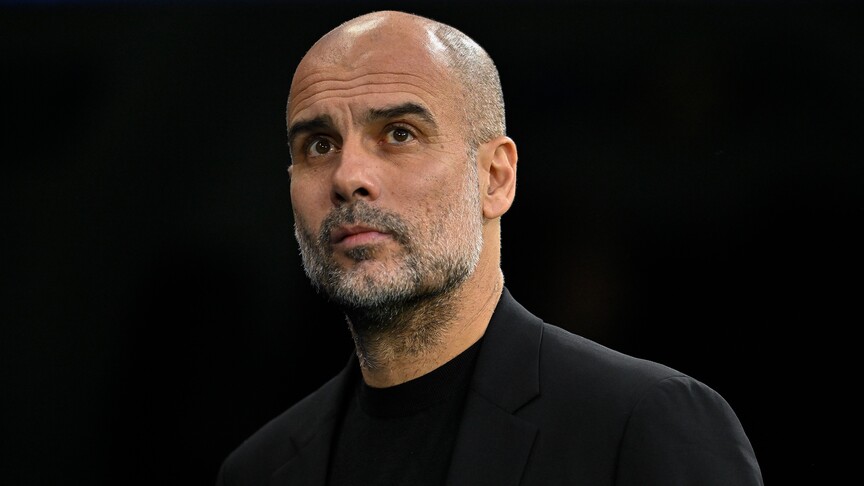
When Pep Guardiola walks out of the Etihad Stadium tunnel for the final time on Sunday, the moment will carry the weight of far more than a managerial farewell.
It will mark the end of one of football’s defining eras – a decade in which Guardiola transformed Manchester City into a footballing empire, while reshaping how the modern game is played across continents.
But Guardiola’s final years with the Sky Blues also came to reflect something beyond tactics and trophies. As Israel waged its genocidal war on Gaza, the Catalan coach emerged as one of the few figures at the top of world football willing to speak about Palestinian suffering, turning public appearances into rare moments of moral commentary in a sport often uncomfortable with political risk.
His departure closes a chapter that delivered unprecedented success and altered the identity of both the club and the Premier League itself.
“Nothing is eternal, if it was, I would be here. Eternal will be the feeling, the people, the memories, the love I have for my Manchester City,” Guardiola said.
“Don’t ask me the reasons I’m leaving. There is no reason, but deep inside, I know it’s my time.”
His final Premier League match against Aston Villa will bring down the curtain on a managerial reign that often felt less like coaching and more like authorship.
The architect of modern football
Long before Manchester, Guardiola had already changed football once.
Born in Santpedor, near Barcelona, he emerged from FC Barcelona’s La Masia academy as the cerebral midfielder at the heart of Johan Cruyff’s “Dream Team.”
Guardiola’s football journey after Barcelona also reflected a career that stretched well beyond Spain. After leaving the club in 2001, he moved to Italy, playing for Brescia and Roma. He later joined Al Ahli in Qatar and finished his playing career with Dorados de Sinaloa in Mexico, retiring in July 2006. He also earned more than 40 caps for Spain.
But it was on the touchline where his influence became generational.
When Guardiola took over Barcelona in 2008, he inherited talent. What he built was ideology, and his Barcelona side – with the likes of Lionel Messi, Xavi Hernandez and Andres Iniesta – elevated “tiki-taka” from tactical system to footballing doctrine.
In his first season, Barcelona won the treble. Between 2008 and 2012, Guardiola collected 14 trophies and produced a team many still regard as the greatest club side in football history.
His years at Bayern Munich deepened that tactical revolution, even without another Champions League title. By the time he arrived in Manchester in 2016, Guardiola was no longer simply a coach. He was football’s central thinker.
At City, his ideas reached industrial scale.
The goalkeeper became a playmaker. Full-backs drifted into midfield. Defenders became creators. Positional rotations blurred the distinction between structure and improvisation.
English football, once skeptical of Guardiola’s methods, eventually bent around them.
City became the first Premier League side to reach 100 points in a season. They won four straight league titles. In 2023 came the treble – Premier League, FA Cup and Champions League – the crowning achievement of Guardiola’s Manchester project.
In total, he leaves City with 20 trophies – nearly half of the 41 he lifted over his entire managerial career – and a legacy that stretches far beyond silverware.
The manager who spoke up
Yet Guardiola’s final years in Manchester were also defined by another role: one of the most prominent voices in global sport to openly condemn Israel’s war on Gaza.
At a time when football institutions, sponsors and players often avoided public political positions, Guardiola repeatedly chose to speak.
Last year, he skipped a pre-match press conference to attend an “Act x Palestine” solidarity event in Barcelona, appearing in a Palestinian keffiyeh and delivering some of the most direct comments made by a major football figure since the war began.
“When I see a child in these past two years with these images on social media, on television, recording himself, pleading, 'where is my mother?' among the rubble, and he still doesn't know it,” Guardiola said.
“And I always think: 'What must they be thinking?' And I think we have left them alone, abandoned.”
Ahead of a Carabao Cup semifinal against Newcastle United, Guardiola again used a football press conference to speak about civilian suffering.
“Never in human history have we had everything so clearly in front of our eyes,” he said. “The genocide in Palestine, what happened in Ukraine, in Russia, in Sudan – everywhere. This is our problem as human beings.”
“It’s not only about Palestine. It’s about every cause that can make humanity better.”
The subject surfaced again during his honorary doctorate speech at the University of Manchester in 2025, where football gave way entirely to human anguish.
“It's not about whether I'm right, or you're wrong. Come on. It's just about the love of life, about the care of your neighbor,” Guardiola said.
“Sorry, but I see my kids when I wake up every morning since the nightmare started with the infants in Gaza. And I'm so scared. Maybe this image feels far away from where we are living now. And you might ask what we can do.”
While Guardiola’s comments have been widely praised, they have also drawn criticism. Last year, the Jewish Representative Council of Greater Manchester & Region wrote to Manchester City chairman Khaldoon Al Mubarak, warning that his words put the lives of Jews in Manchester “in danger.”
His concern, however, has not been limited to Gaza. In 2018, he was fined £20,000 ($27,000) by the Football Association for wearing a yellow ribbon in support of imprisoned Catalan politicians.
At a news conference in February, he also spoke about violence in Ukraine, Sudan and the deaths of two people in the US involving ICE agents.
“When you have an idea, and you need to defend (it), and you have to kill thousands, thousands of people – I’m sorry, I will stand up,” he said. “Always, I will be there. Always.”
A farewell larger than football
City said Guardiola will remain connected to the wider City Football Group as an ambassador and adviser after leaving the dugout.
Tributes have already flooded in from across football. Club chairman Al Mubarak announced that the Etihad Stadium's North Stand will be renamed the “Pep Guardiola Stand.”
Yet, Guardiola’s influence cannot be contained within statues, stands or trophies.
He changed the geometry of football. He altered how coaches think, how players move, how clubs recruit and how fans understand the game itself.
And in a football era often defined by caution and corporate silence, Guardiola also became something increasingly rare: a sporting figure willing to speak publicly about human suffering beyond the stadium.
On Sunday, Manchester City will say goodbye to the most successful manager in the club’s history.
Football, however, will be saying goodbye to one of the defining figures of its age.
news_share_descriptionsubscription_contact

contact_the_ombudsman
is_there_an_error_in_this_story