Bahattin Gonultas and Emir Yildirim
03 October 2026•Update: 03 October 2026
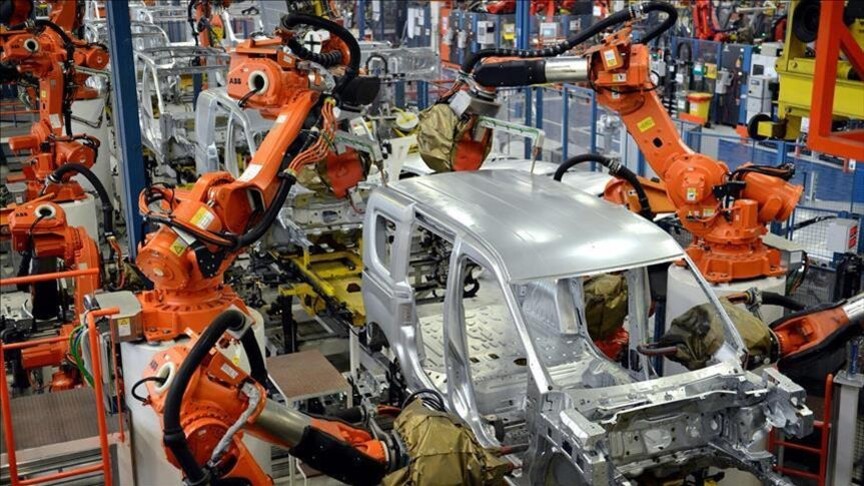
The ever-growing developments in artificial intelligence (AI) and supply chains drove global factory automation adoption to historic highs, with the global active industrial robot inventory surpassing 5 million last year, according to a report.
The International Federation of Robotics said the operational robot stock rose 9% on an annual basis and global installations jumped 11% to more than 600,000 units.
China boasts an overwhelming dominance in the field, expanding annual robot installations by 20% to 354,000 units, making up 59% of the global deployment, while domestic firms secured 55% of the market share in the country.
Japan’s installations fell 19% to 36,219 units, falling from second place to be replaced by the US, which posted a 12% surge to 38,500 robots.
South Korea maintained its fourth position with 30,200 annual robot installations, followed by Germany with an 8% decline to 24,800. India had a 15% surge to 10,500.
Germany’s growth decelerated while accounting for 41% of all EU installations, alongside contractions in Italy, France, and Spain.
The global robot demand is expected to rise in the coming years, with installations climbing to 655,000 units this year and 806,000 by 2029.
Persistent labor shortages in advanced economies, supply chain reshoring and AI-focused technologies lowering deployment costs for small- and medium-sized enterprises (SMEs) drove the expansion in robot installations.
At the same time, Türkiye ranked 17th in the global robot market last year, while robot installations declined 9% to 3,194 units, down from its record of 4,429 units in 2023.
Türkiye’s operational stock rose 7% to a record of 30,990 units, ranking 15th worldwide in the robot fleet.
The country’s metal industry remained the top automation buyer among other sectors, as installations rose 8% to 990 units to capture 31% of the market, with 6,774 robots in active duty.
The Turkish auto sector’s robot inventory climbed 3% to 889 units, accounting for 28% of new installations and maintaining 11,017 active units.
Demand weakened in other sectors, with annual robot installations in the electrical/electronics sector, including home appliances and electrical machinery, falling 37% to 136 units, while adoption in the food products, beverages and tobacco products segment saw annual robot installations plummet by 40% to 144 units.
Some 59% of all new robots were deployed for handling operations/machine tending and 16% for welding and soldering, the report showed.
The report added that the robot density remains quite low, with 52 units per 10,000 workers in the manufacturing industry, while the density was better in the auto sector, reaching 374 per 10,000 workers, compared to a rate of 35 units per 10,000 workers in other industries.