By Michael Hernandez
WASHINGTON
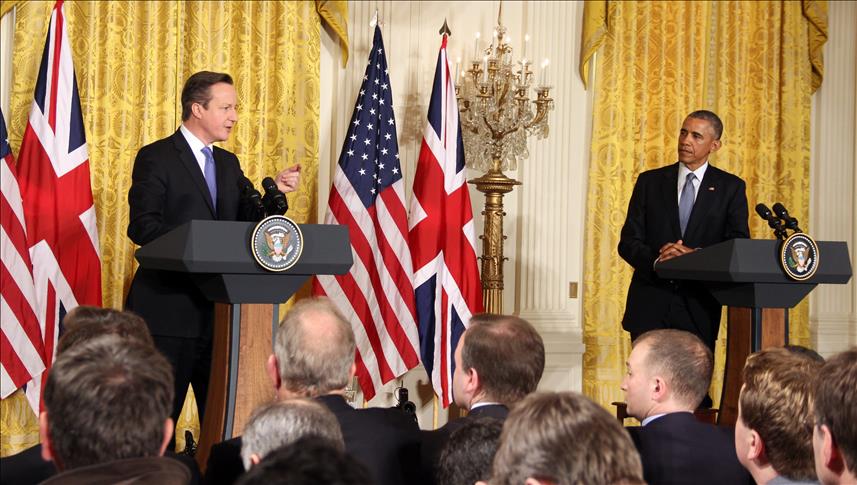
President Barack Obama and British Prime Minister David Cameron vowed Friday to jointly fight the threat posed by violent extremism following a deadly attack in Paris, and anti-terror raids in Europe.
“This is a problem that causes great heartache and tragedy and destruction, but it is one that ultimately we're going to defeat,” Obama said during a joint press conference.
“We know what we're up against. And we know how we will win,” Cameron said.
The prime minister added that the West is being confronted by a “poisonous, fanatical death cult of a narrative that is perverting the religion of Islam.”
Obama stuck with his administration’s phrasing of the threat, avoiding directly linking it to Muslims or Islam in preference for terms such as “violent extremism.”
The leaders spoke in the East Room after a bilateral meeting at the White House. They met the previous night for a working dinner.
Cameron’s trip to the U.S. was the first following deadly attacks in Paris that killed 17, as well as foiled terror plots in the U.S., and Belgium.
Obama said that the Paris attacks “underscored again how terrorist groups like al-Qaeda and ISIL are actively trying to inspire and support people within our own countries to engage in terrorism.”
The two attackers who went on a shooting spree at a Paris-based French satirical magazine were reportedly acting on orders from top al-Qaeda leader Ayman al-Zawahiri. A third attacker, who killed customers and a policewoman in a kosher supermarket, allegedly pledged allegiance to ISIL.
European governments have ramped up efforts to combat terrorism following the attacks, with Cameron saying Monday that he would seek new regulations on encrypted messaging apps that could bar popular ones such iMessage, WhatsApp, and Snapchat.
“As technology develops, as the world moves on, we should try to avoid the safe havens that could otherwise be created for terrorists to talk to each other,” Cameron said. “We believe in very clear front doors through legal processes that should help to keep our country safe.”
Technology companies ramped up efforts to increase consumer privacy measures following a series of leaks from former NSA contractor Edward Snowden that exposed large-scale government data collection programs.
Obama said that he was confident that the U.S. could balance privacy and security concerns, “and we shouldn't feel as if because we've just seen such a horrific attack in Paris that suddenly everything should be thrown by the wayside.”
Before leaving for Washington, Cameron announced that the U.S. and UK would engage in cyber “war games” in a bid to increase cooperation on cyber threats. The first round of the games is scheduled for later this year.
An initial joint exercise will focus on the financial sector, the White House said in a statement Friday. The two countries will also create a “cyber cell,” with operating presences in both countries. The aim of the cell will be to increase data sharing and cyber security cooperation.
Cameron’s visit to the U.S. as Prime Minister might be his last with elections scheduled for May.
Obama, Cameron warn Congress against new Iran sanctions
President Barack Obama strongly warned Congress against new Iran sanctions Friday, saying that additional penalties could derail ongoing talks.
“Congress needs to show patience,” Obama said during a joint press conference with British Prime Minister David Cameron. “I respectfully request them to hold off for a few months to see if we have the possibility of solving a big problem without resorting potentially to war.”
Obama said the likelihood that ongoing nuclear talks with Iran would be scuttled if Congress were to introduce new sanctions legislation is ‘very high,’ and that he would veto any such legislation that reaches his desk.
“I will make this argument to the American people as to why I'm doing so,” Obama warned.
The British prime minister said that he has called U.S. senators to avoid introducing any new sanctions, saying that existing sanctions have led to the ongoing talks with Iran over its nuclear program, “and those talks at least have a prospect of success.”
If new sanctions were to be introduced, Iran would be able to walk away from the talks, saying “that the reason that they ended negotiations was because the United States was operating in bad faith and blew up the deal,” Obama argued.
“And there would be some sympathy to that view around the world, which means that the sanctions that we have in place now would potentially fray because imposing these sanctions are a hardship on a number of countries around the world,” he added.
Negotiators have until March to reach a political agreement, with a final deal deadline set for the end of June.
The U.S. and Iran are currently engaged in bilateral talks in Geneva set to end Saturday. Multilateral talks with the full P5+1 group of world powers will begin the following day.
The group includes the U.S., China, France, the UK, Russia and Germany.
Two deadlines have already passed without the comprehensive accord sought by the parties.