ANKARA
By Selen Tonkus
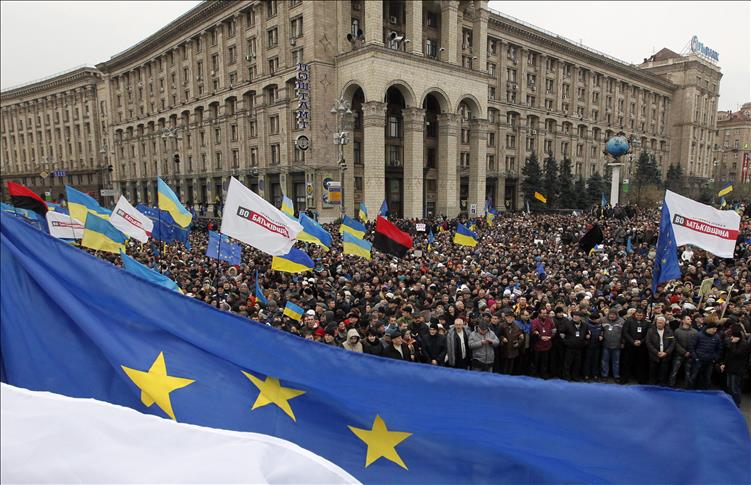
Protests in Ukraine, started upon President Viktor Yanukovich's s rejection of the Deep and Comprehensive Free Trade Agreement (DCFTA) planned to be signed between the EU and Ukraine, continue to occupy headlines. Experts think the demonsrators will continue for a while more albeit in a decreasing fashion, while Yanukovich will stay in power, and the EU should invest efforts to "europeanize the country in a more controlled way."
Protests would stay on a more or less same level, which was characterised by high intensity and mass numbers, focusing specifically on capital city of Kyiv, said Volodymyr Dubovyk,Director, Center for International Syudies at Odessa I. Mechnikov National University.
"A lot of people might go to their workplaces for the week-days, but some will stay at the streets, plus lots of activists have arrived from the regions" he said in interview to Anadolu Agency.
As for Yanukovich, Dubovyk claimed that he would not resign, adding "Most probably he is going to stay till the end of his current term and run again in 2015."
"However," said Dubovyk, "If indeed pressure from the protesters persist, he would sack either the entire government or, at least, some of those most directly responsible for the violence against the protesters. Also, there might be a new configuration in the parliament,"
Asked whether Yanukovich supporters could also take the streets, Dubovyk said his constituency in the East and South could not organize enthusiastic and wide scale protests.
About the EU's position, Dubovyk said that the EU watched the events closely.
"The agreement is still there to be signed by Ukraine. If president addresses the issue of violence against protesters properly and engages in a political dialogue with opposition, he might be seen by EU as eligible for signing, if not, then possible signing will be delayed till after the next presidential elections to take place in 2015."
-"EU faces tricky issue"-
Ukrainians on Kyiv streets were frustrated, said Kataryna Wolczuk from Centre for Russian and East European Studies at the University of Birmingham.
"The political opposition leaders have no clear strategy, so they are likely to struggle to keep people on the streets to achieve their goal, for example by exerting pressure on president Yanukovych to resign."
Stating that Yanukovich still was powerful as he was supported by the business people, Wolczuk also said that he would try but fail in organizing rallies because "even in Eastern Ukraine people are tired of him."
Wolczuk added that the EU would like to strengthen Ukraine's European orientation by offering some extra package, but they had to treat very carefully because this could aid Yanukovych staying in power.
"So it's a tricky issue that the EU faces."
englishnews@aa.com.tr