GENEVA
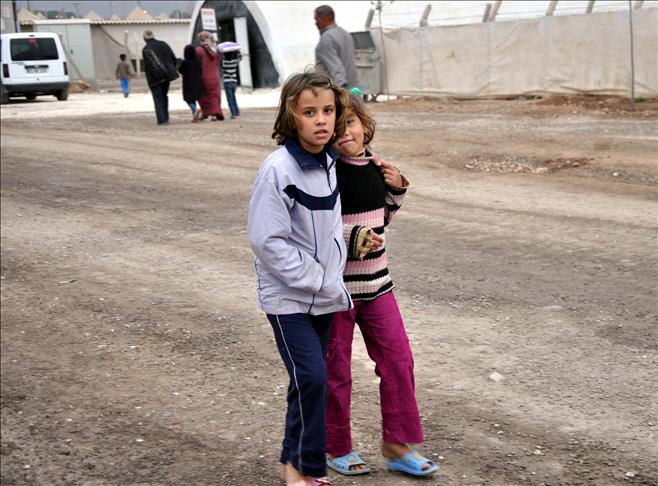
Nearly 5.5 million vulnerable Syrian children will soon face another season of harsh winter weather.
"Last January brought the coldest temperatures in more than a decade and UNICEF is very concerned that exposure to similarly cold and wet conditions will place further strain on the health and wellbeing of displaced Syrian children," a spokeswoman for the UN Children's Fund (UNICEF), Marixie Mercado said in the UN Office at Geneva on Tuesday.
Mercado said "The scale of the humanitarian response needed for the looming winter is unprecedented. In December of last year, there were approximately 1.15 million children affected by the crisis inside Syria, with an additional 232,000 Syrian children living as refugees in neighbouring countries."
Today as the conflict approaches its fourth year, those numbers have skyrocketed to 4.3 million and 1.2 million, respectively. “Millions of displaced Syrian children have had to find safety under what are, frankly, inadequate living conditions,” said Maria Calivis, UNICEF Regional Director for the Middle East and North Africa.
Calivis said “When freezing temperatures and rain are added to the mix, children under five are especially susceptible to opportunistic illnesses like acute respiratory infections which spread easily in overcrowded settings.”
There are currently more than 436,000 Syrian refugee children under the age of five in Lebanon, Jordan, Iraq, Turkey and North Africa living in refugee camps, tented settlements and host communities. “Together with our partners, we have already mobilized emergency supplies in Syria and the region to keep children warm, dry and healthy this winter,” said Calivis.
The situation facing the more than 400,000 Syrian child refugees in Lebanon is especially precarious as thousands of families are currently sheltering in tented settlements on flood-prone land. Should tents and latrines be flooded with rain, there is an increased risk of exposure to water borne diseases. UNICEF in Lebanon is distributing 88,000 winter clothing kits to children living in tented settlements across the country.
Each kit includes a jacket, waterproof boots, gloves, scarf, wool hat and warm underclothes. UNICEF is also working to reinforce drainage systems, desludge waste tanks and construct concrete foundations for families in tents. Additional supplies such as energy boilers for hot showers are also being placed in camps.
In Syria itself, UNICEF plans to reach 2,000,000 children with a package of emergency supplies for the winter. The package will include winter clothing for children, blankets, plastic sheeting, and hygiene kits.·
In Jordan, UNICEF will provide 35,000 winter clothing kits for Syrian refugee children under five, in addition to 24,000 blankets.·
To keep children in school, UNICEF is procuring 370 winterized tents for classrooms and child friendly spaces in Syrian refugee camps in Iraq and Turkey, along with fuel for heating,"
A second winter is bearing down on Syrian children, and with the freezing cold and driving rain come particular risks to the very young, the displaced inside Syria, and children living in informal settlements across the region.
The numbers of Syrian children in need of humanitarian assistance have practically quadrupled since last winter.
Today there are about 4.3 million children in need of assistance inside Syria – including about 3 million internally displaced children; plus almost 1.2 million Syrian child refugees, including more than 436,000 children below 5 years old. That is nearly 5.5 million children in need of assistance out of a pre-conflict population of about 9 million children.
This is how a 13-year-old refugee in Za’atari camp described conditions last winter: “Winter last year was very bad. When we arrived in Za’atari, we were given one tent and a blanket each. But after two days, it became very cold and the rain came down hard – it didn’t stop. We had to sleep together all of us to stay warm. During the second night of rain, our tent flooded and it was like we were swimming. I went outside to try to dig trenches around the tent to collect the water, but it didn’t work and the tent was covered in water and mud. So we had no choice but to sleep like that. The next day, my mother and brothers went to stay in the school with other families. Over the next few weeks, we all got sick except for my mother. I remember being so angry that we were in this situation. I hope this winter will be better.”
englishnews@aa.com.tr