JERUSALEM
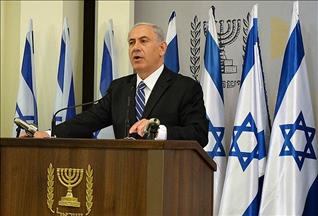
Peace with the Palestinians made it necessary for the Palestinian leadership to recognize the Jewish nation-state and stop incitement against Israel and the Jewish people, Israeli Prime Minister Benjamin Netanyahu said Monday.
"Palestinian Authority President Mahmoud Abbas reiterated that he would never recognize the legitimacy of the Jewish people's right to have a nation-state," Netanyahu was quoted by his spokesman Ofir Gendelman on his Twitter account as adding during a meeting with Serbian Prime Minister Aleksandar Vucic.
He said Abbas said this on November 29, which happened to be the 67th anniversary of United Nations declaration of the independence of Israel.
Netanyahu was referring to the United Nations Partition Plan for Palestinian, which was never implemented and went down in history as "Resolution 181."
"Many of our Palestinian neighbors deny the more than 3000 year-old connection between the people of Israel and the Land of Israel," Gendelman quoted Netanyahu as saying.
Addressing an Arab foreign ministers meeting at the Arab League in Cairo on November 29, Abbas said he would not recognize the Jewish nation-state.
The roots of the current conflict between the Palestinians and the Israelis date back to 1917 when the British government, in the now-famous "Balfour Declaration," called for "the establishment in Palestine of a national home for the Jewish people."
Jewish immigration rose considerably under the British administration of Palestine, which was consolidated by a League of Nations "mandate" in 1922.
In 1948, with the end of the mandate, a new state – Israel – was declared inside historical Palestine.
As a result, some 700,000 Palestinians fled their homes, or were forcibly expelled, while hundreds of Palestinian villages and cities were razed to the ground by invading Jewish forces.
The Palestinian diaspora has since become one of the largest in the world. Palestinian refugees are currently spread across Jordan, Lebanon, Syria and other countries, while many have settled in refugee camps in the Palestinian West Bank and Gaza Strip.
Israel went on to occupy East Jerusalem and the West Bank during the 1967 Middle East War. It later annexed the holy city in 1980, claiming it as the capital of the self-proclaimed Jewish state – a move never recognized by the international community.
Palestinians want the establishment of an independent Palestinian state in the Gaza Strip and West Bank, with East Jerusalem as its capital.
For many Palestinians, the right to return to their homes in historical Palestine – as enshrined in UN General Assembly Resolution 194 – remains a key demand.
www.aa.com.tr/en