ANKARA
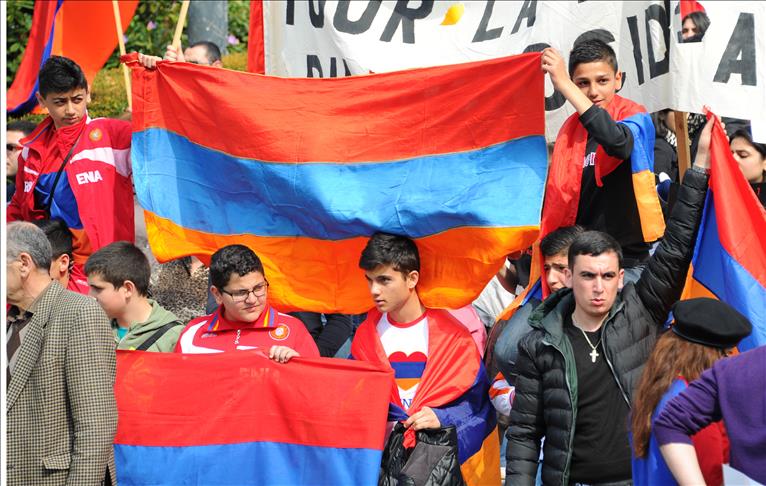
The condolences expressed by the Turkish prime minister to the Armenian community on Wednesday last week on the anniversary of the 1915 incidents, are met with muted enthusiasm by Armenian academics.
In Recep Tayyip Erdogan's statement, released in nine languages, including Armenian, the incidents of 1915 are referred to as “inhumane.” The statement attracted worldwide media attention.
Events dubbed "the 1915 incidents" took place during World War I, when a portion of the Armenian population living in the Ottoman Empire sided with invading Russians and rose up against the Ottoman authority. The uprisings were followed by a decision by the Ottoman-era officials to relocate the Armenians living in eastern Anatolia.
As a result, an unknown number of people died amid civil strife.
A Turkish Armenian intellectual and columnist at Zaman daily spoke to Anadolu Agency (AA). Etyen Mahcupyan sees Erdogan's comments in line with ruling AK Party's efforts to create a multicultural Anatolian society. Its efforts to bring broader political rights, education in mother tongue languages such as Kurdish and tougher penalties for hate speech were seen in last September's "democratization package."
Part of this package ruled on the return of property and artefacts to the Christian minorities. Turkey returned part of the land to the historic Mor Gabriel Monastery - the oldest surviving Syriac Orthodox monastery in the world - in Turkey’s southeast region in March.
Mahcupyan says the AK Party is pursuing the formation of a new societal ideology in Turkey. He said the AK Party’s efforts will result in a new way of living together without "religious or ethnic hierarchy.”
Artur Ghazinyan, an expert on human rights and democratization at the Armenia-based, Centre for European Studies, told AA the statement was a "necessary step" to be taken before the centennial anniversary due next year of the 1915 incidents.
Ghazinyan says Erdogan's comments apparently show that the Turkish authorities have initiated a process that would create an image that Turkey has changed her attitude towards this problem.
However, Ghazinyan says a lot more needs to be done. Instead of historians working on the incident, Ghazinyan suggests “a committee of international law experts” and also a “UN criminal tribunal, who would work together to develop the international legal qualification of the 1915 acts.”
Ghazinyan says this is necessary "if the Turkish government and people are willing to face up to their violent and tragic history and reconcile their relations with the Armenian diaspora."
The government should also go further he suggests by ending the closure of the border and establishing diplomatic and trade relations with Armenia.
englishnews@aa.com.tr