Hussien Elkabany and Rania Abushamala
06 October 2026•Update: 06 October 2026
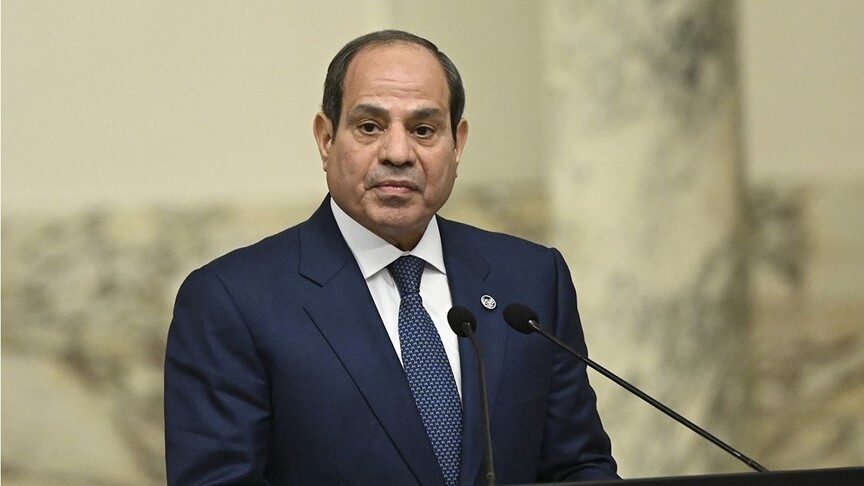
Egyptian President Abdel Fattah al-Sisi rejected any infringement on Egypt’s share of Nile waters, attempts to displace Palestinians or moves to circumvent implementation of the Gaza ceasefire agreement.
Sisi spoke Monday while chairing a meeting of the Supreme Council of the Armed Forces at the Strategic Command headquarters in the New Administrative Capital east of Cairo, according to a presidential statement.
The meeting formed part of celebrations marking the 53rd anniversary of Egypt’s October 1973 war against Israel.
“The Nile is the very lifeline of Egypt and the cornerstone of its existence across millennia,” he said.
“Egypt’s water share is an established historical and non-negotiable legal right that admits of no compromise or infringement.”
He said Egypt remains committed to cooperation and joint development with fellow Nile Basin countries but would not allow any measures that undermine its water security.
Egypt “shall continue to defend its rights by all means sanctioned under international law,” he added.
Egypt and Sudan, the two downstream Nile countries, are locked in a dispute with upstream Ethiopia over its dam and the absence of a binding agreement governing its filling and operation. Cairo fears the project could affect its annual water allocation of 55.5 billion cubic meters.
Turning to Palestine, Sisi reiterated Egypt’s “categorical rejection of any attempts aimed at displacing the Palestinian people from their land.”
He also called for full implementation of US President Donald Trump’s Gaza ceasefire plan, warning against circumventing or disregarding it.
Sisi stressed the importance of establishing an independent Palestinian state in accordance with international resolutions, describing it as the only guarantee of a just and lasting peace and stability in the Middle East.
He cited Egypt’s peace agreement with Israel as evidence that prolonged conflict can give way to coexistence.
Egypt and Israel fought wars over decades before the courage and foresight of their political leadership, supported by US mediation, opened the door to peace and ended hostilities, he said.
“Peace is by no means an unattainable aspiration but a viable choice capable of resolving conflicts and fostering peaceful coexistence among peoples,” Sisi added.
Egypt and Israel signed a peace treaty in Washington, DC on March 26, 1979, following the 1978 Camp David Accords.
Addressing regional developments, Sisi said the Middle East faces crises and turmoil, while rapid global changes and unprecedented challenges have destabilized countries and displaced millions.
He warned that challenges to Egypt’s stability persist but said the country’s institutions and the cohesion of its people enable it to protect its national security.
He reaffirmed Egypt’s support for the unity, sovereignty and territorial integrity of Arab countries and the protection of their national institutions.
“The security of the Arab Gulf States is an integral and inseparable part of Egypt’s national security,” he said, renewing Egypt’s condemnation of attacks targeting Arab countries.
He also stressed the need to preserve freedom of navigation through international maritime routes.
Egypt’s armed forces remain ready to defend the country, its resources and national security “at all times and under all circumstances,” Sisi said.