Poor pay, poor health for women rolling Indian cigarettes
A thin parcel of tobacco wrapped in leaves, the 'bidi' is India's most popular cigarette, but the women who roll it face poor working conditions and risk permanent damage to their health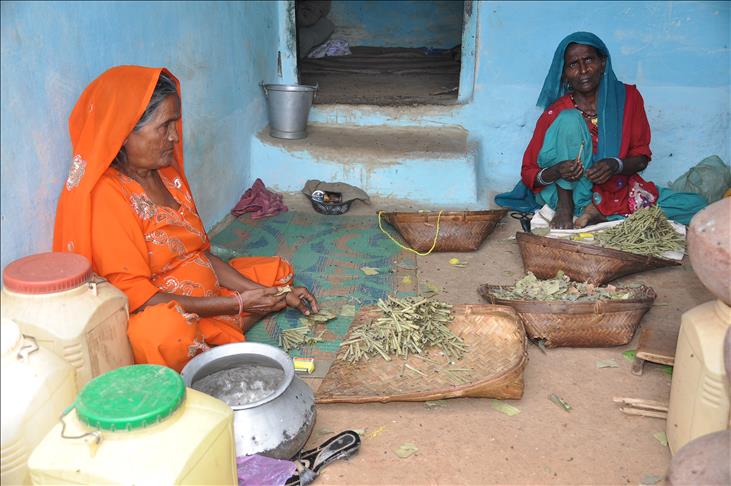
By Shuriah Niazi
BHOPAL, India
Sajida Khan and her family earn their living by spending their days rolling bidis, a popular Indian cigarette made of loose tobacco wrapped in leaves from the common tendu tree. Her husband and three children cut the leaves and put them into water to soften, then she rolls them into a thin parcel tied together with string. The family are paid around 40 Indian rupees, about 66 cents, for each batch of 1,000 bidis.
“I need the money to sustain my family. We don’t have any other source of income," says Sajida. "We know bidi rolling is giving us different kinds of problems. But we can’t do anything else. One has to do something for livelihood and we are doing this work.”
The bidi is cheaper than conventional cigarettes and make up almost half of all tobacco sales in India, while cigarettes make only 14 percent, according to a report by the International Union Against Tuberculosis and Lung Disease. The industry employs more than 6 million in India, despite poor pay and working conditions. Central Indian state Madhya Pradesh is the centre for the industry, with 17 percent of all workers in the state involved in bidi production.
Bidi rollers once worked in factories but are now mostly confined to their homes. Women making up 90 percent of the workforce and children much of the rest because it is generally believed they have the deft fingers needed for rolling the thin cigarettes. Most workers commonly belong to the Muslim community and disadvantaged castes and tribes.
“We are totally dependent on this work. We can’t do any other work as we’re not educated or skilled. We know our family suffers because of bidi rolling, but we cannot leave this profession,” says Anjuman, who works in Madhya Pradesh's Sagar district, where much of bidi production is centered.
The industry provides employment to hundreds of thousands of families, but unorganized and with employment laws unenforced, they are also left vulnerable to exploitation. Bidi workers received the lowest wages of any occupation in India; most families only manage to earn up to 500 Indian rupees ($8) per week.
“You cannot think how bidi workers are exploited here. They are not getting the minimum wages. Besides the entire family is involved in rolling, the children cannot receive education. This way they continue with the work of bidi rolling," says Hafiz Haroon, a social worker in Sagar. "In most cases, middle men or sattedar (contractors) decide about the payment to be made to workers. They usually reject 20-30 percent of bidis claiming they are of poor quality and thus deprive workers of their genuine income.”
“We want the government to register each and every bidi worker, so that it will be easy for us to trace children working in bidi industry,” says Haroon.
Bidi rolling also poses a major health risk for workers. They are extensively exposed to the nicotine in cigarettes, which is carcinogenic and comes into direct contact with their skin. They spend most of their days in small rooms, without masks, directly inhaling tobacco particles.
India's ministry of labor has found that tuberculosis is more common amongst bidi workers than any other group in the general population. In Sagar's Rahantgarh area, where most depend on bidi rolling for subsistence, it is believed that every second house has someone suffering from the condition.
“I’m suffering from lung tuberculosis. Continuous rolling of bidis and contact with tobacco cause tuberculosis. It is curable but I have to stop making bidis, which is not possible for me," says Shabnam, who has suffered with the condition for three years. "How shall we survive if we stop making bidis? I have to work, no one is going to work for me.”