
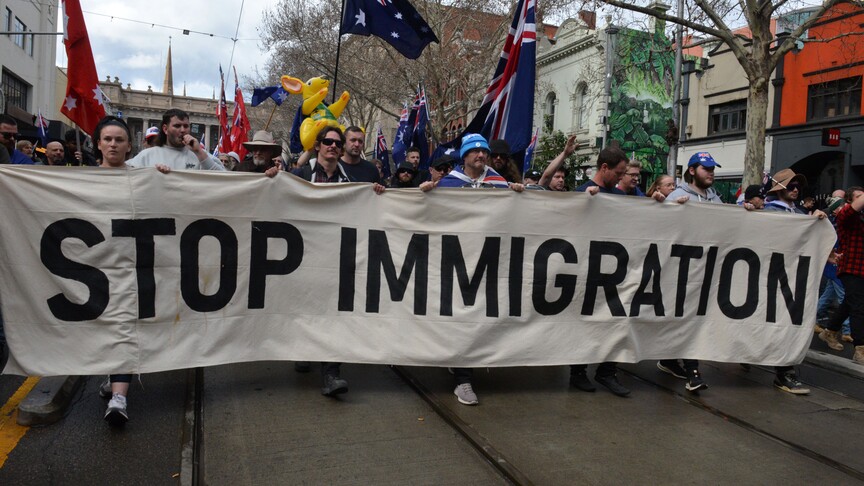
Australia’s Victoria state heads to the polls Saturday, with the far-right One Nation seeking a breakthrough as voters weigh ending 12 years of Labor government in a state long regarded as a progressive stronghold.
The opposition Liberal-National Coalition, led by Jess Wilson, is favored to win.
But One Nation could expand from a single upper-house representative into a parliamentary force capable of shaping the next government’s agenda.
For Labor Premier Ben Carroll, polling points to more than the possible loss of office. One major survey suggests the party’s first-choice vote could fall to its lowest level since 1902.
A total of 1,037 candidates are contesting 88 lower-house and 40 upper-house seats in what the Victorian Electoral Commission described as the state's "biggest and most complex state election yet.”
Here is what is at stake in Australia’s second-most populous state.
Nationally led by Pauline Hanson, One Nation has built its appeal around restricting immigration and challenging the major parties.
Its leader in Victoria, Warren Pickering, is a former Army combat engineer who has also worked in construction and coal mining. He is contesting Pakenham, a lower-house seat in Melbourne’s southeast.
The party’s state campaign combines promises to reduce living costs with tougher criminal penalties and opposition to Labor’s energy and Indigenous affairs policies.
It proposes reversing land tax increases, raising the threshold at which businesses pay payroll tax and reducing the cost of building homes. On crime, it wants faster court proceedings, tighter bail arrangements and adult sentencing for children convicted of serious offenses.
One Nation also wants to scrap net-zero emissions targets and subsidies, encourage investment in coal power and reverse restrictions on gas connections in new homes.
Its proposals include repealing the state’s treaty arrangements with First Nations people and banning burqas and niqabs in schools.
Nationally, the party has proposed reducing the temporary migrant population by 750,000 over three years, followed by an annual net migration cap of 130,000.
One Nation could go from a single upper-house representative to a significant presence in both chambers of Victoria’s parliament.
The party has already made gains elsewhere. In South Australia’s March election, it won 22.9% of first-choice votes and four lower-house seats, just one fewer than the Liberals.
In Victoria, a YouGov survey of 4,360 voters, using modeling to estimate individual seat results, projected 55 lower-house seats for the Coalition, 13 for Labor, 12 for One Nation and eight for the Greens, according to News24.com.au and the Herald Sun.
The model gave One Nation a possible range of four to 18 seats, depending on how voters’ preferences flow.
Labor could fall from its current 54 seats to between eight and 21, potentially leaving it competing with One Nation to become the largest opposition party.
The survey put One Nation’s first-choice support at 21%, ahead of Labor’s 20%, but behind the Coalition’s 31%. The Greens stood at 16%.
However, leading on first-choice votes does not guarantee victory under Victoria’s preferential voting system. The model suggested One Nation could lead the initial count in as many as 30 districts, but votes transferred from eliminated candidates could help its opponents overtake it.
Its influence could be particularly significant in the upper house.
The same modeling projected 13 of the chamber’s 40 seats for the Coalition, 11 for One Nation, seven each for Labor and the Greens and two for the Victorian Socialists.
That would leave the Coalition short of the 21 seats required for a majority. Even with a comfortable lower-house victory, a Wilson government could therefore need support from One Nation or Labor to pass legislation.
Cooperation would not necessarily be straightforward.
On Friday, One Nation opposed the Coalition’s proposed long-term private lease of Melbourne’s sewage facilities. Pickering said his party wanted to give the plan “the flush,” according to broadcaster ABC.
The projections vary across polls, however. DemosAU’s final survey, released Thursday, put One Nation’s first-choice support in the lower house at 16% and projected seven to 10 upper-house seats, highlighting uncertainty over the scale of its breakthrough.
Economic management, crime and living costs have emerged as major concerns.
According to polling reported by News.com.au, managing Victoria's economy and finances was the biggest concern among voters, cited by 29% of respondents.
Crime and community safety ranked second at 26%.
Housing affordability, wages failing to keep pace with prices and pressure on public hospitals have also featured in the campaign.
The Coalition and One Nation are both seeking to capitalize on dissatisfaction after three consecutive Labor terms, although they are competing for some of the same voters.
A Coalition victory could reverse several major Labor policies.
Wilson has presented her program as a way to “fix” Victoria after years of Labor rule.
Among its key commitments is repealing Australia's first formal treaty with First Nations people, introducing tougher bail laws and sentencing measures for children, and imposing tighter restrictions on protests.
The Coalition has also pledged to expand gas exploration, scrap a major renewable-energy transmission project and reverse the ban on gas connections in new homes.
These policies overlap with parts of One Nation’s agenda, although the Coalition has not proposed abandoning Victoria’s emissions reduction targets.
Carroll, meanwhile, has urged voters to protect Labor’s legacy. On Friday, he appealed to Wilson not to repeal the treaty or close an existing medically supervised injecting facility.
“We know we’re a progressive state, we’re a great state,” he said, according to ABC.
Polling places open Saturday, Nov. 28, from 8 am to 6 pm local time (2100GMT Friday to 0700GMT Saturday).
Counting begins after polls close, with preliminary results emerging during the evening.
A clear result could indicate the next government that night, but close contests may take longer as postal votes and preferences are counted.
The upper-house outcome is set to take longer to finalize. The electoral commission expects those results to be calculated on Dec. 16, with all election results formally declared by Dec. 19.
That means voters may learn who will govern Victoria well before knowing exactly how much parliamentary influence One Nation has secured.
news_share_descriptionsubscription_contact

contact_the_ombudsman
is_there_an_error_in_this_story