


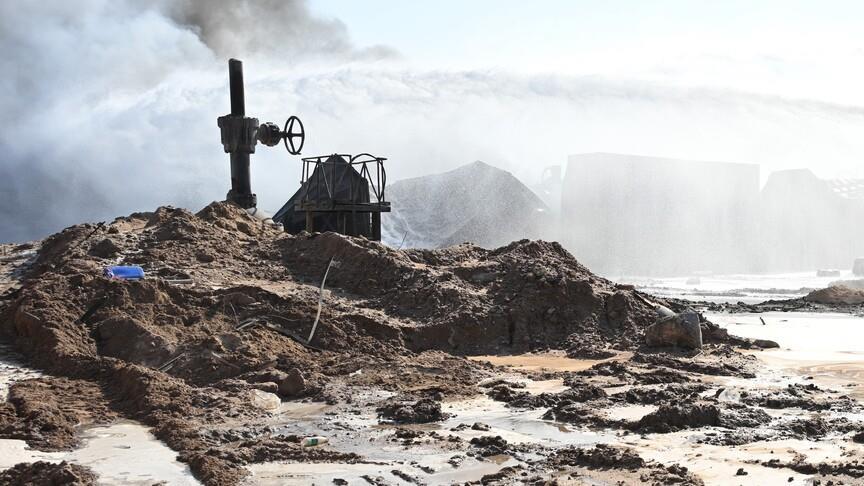
The Gulf Cooperation Council (GCC) secretary-general on Friday condemned "in the strongest terms" a drone attack targeting Saudi Arabia's East-West Pipeline in the capital Riyadh and Madinah regions, which Riyadh said originated from Iraq and caused injuries and property damage.
Jasem Mohamed Albudaiwi said the attack represents "a dangerous escalation and an unacceptable threat to the security of the Kingdom of Saudi Arabia, its territorial integrity, and its vital installations," describing it as "a flagrant violation of the principles of international law."
He urged Iraq to intensify efforts and take "necessary, decisive measures" to prevent its territory from being used as a launchpad for such attacks.
Albudaiwi reaffirmed the council's "complete and steadfast solidarity" with Saudi Arabia, voicing "full support for all measures and actions the Kingdom takes to protect its security, stability, territorial integrity, facilities, citizens, and residents."
- No retaliation ‘at this stage’ from Saudi Arabia
Saudi Arabia said earlier Friday that it had shut down the East-West Pipeline as a precautionary measure after several drones struck the oil pipeline in the Riyadh and Madinah regions on Thursday morning.
The Saudi Energy Ministry said several people were injured and received medical treatment, while the attacks also caused damage to the pipeline. Emergency and technical teams were deployed to secure the facility and assess its condition.
The Saudi Foreign Ministry said the drones originated from Iraq. Riyadh said it had decided not to retaliate "at this stage" after Iraq's prime minister asked Saudi Arabia to allow Baghdad to take measures to prevent further attacks launched from Iraqi territory.
Saudi Arabia said it supported Baghdad's efforts but reserved the right to take all necessary measures to protect its sovereignty, security, and infrastructure.
Iraq condemned the attacks and said its territory and airspace "will not be a launching point for attacks against any country."
Iraqi Prime Minister Ali al-Zaidi, also commander-in-chief of the nation’s armed forces, ordered an investigation into the attacks and directed authorities to take legal action against anyone found to have been involved.
-Rising tensions
Tensions between Riyadh and Baghdad had already risen in July after Saudi Arabia said it intercepted several drones launched from Iraq toward oil facilities in the Eastern Province and Riyadh region. Riyadh blamed Iranian-backed militias and urged Baghdad to prevent Iraqi territory from being used for attacks against the kingdom.
Iraq subsequently formed a joint security committee aimed at preventing unauthorized attacks on neighboring countries.
The dispute escalated on July 29, when US and Saudi forces carried out strikes on sites belonging to the Iranian-aligned Popular Mobilization Forces in Iraq. The PMF said 20 members were killed and 32 others wounded.
Saudi Arabia said the operation was carried out in self-defense following attacks from Iraq on its petroleum facilities.
The East-West Pipeline provides Saudi Arabia with a strategic alternative for exporting crude through the Red Sea as shipping through the Strait of Hormuz remains severely disrupted by the US war against Iran.
By Merve Aydogan in Canada
Anadolu Agency
energy@aa.com.tr
